


This week, we’ve posties getting back on bikes after over a decade’s hiatus. Meanwhile, the robotaxi debate rumbles on, while across the pond there’s positive World Cup legacy news that people can get behind. Elsewhere, National Highways has made some unfortunate decisions around its roadside paths and, we hope, more people are cycling to work.
BIG STORIES FOR CYCLING ADVOCACY
POSTIES ON CARGO BIKES. Royal Mail has cottoned on that e-micromobility might be a better bet for urban deliveries. It’s been over a decade since they phased out delivery bikes for posties - and banned posties cycling at work. Now, the company has started rolling out quadricycles for deliveries in London, Cambridge and Brighton. Kicking off with 20 of the four-wheeled Minimal Pedal 4 cycles, the move is part of the company’s decarbonisation plan, and, as Cycling Electric’s Mark Sutton reports, brings Royal Mail in line with its European operations, and with its competitors Amazon and Evri.
TUSSLE OVER ROBOTAXI LICENSING. London’s streets are currently a testing lab for autonomous taxis, in national trials. There were concerns from London Assembly Transport Committee Chair, Caroline Russell, that TfL had not had a say. This prompted Department for Transport to say that TfL is already responsible for licensing taxis in the city, which has been since confirmed with the news that TfL are granting licences to Wayve and Waymo. Yesterday, on Radio 4’s Today Programme, Licensed Taxi Drivers’ Association’s Steve McNamara described robotaxis as a solution looking for a problem. We’ll find out soon enough (although my opinion is pretty clear, here).
A WORLD CUP LEGACY TO GET BEHIND. New York had ‘soccer streets’, Vancouver had a World Cup pedestrian zone. These two great cities decided the international football tournament was a good excuse to inspire more people to be active - and to give street space back to the people, from cars. New York City had school streets type interventions outside 50 schools to give kids space to play football, make art and enable communities to hold block parties. And Vancouver’s pedestrian zone on Granville Street, set up to show football matches, host activities and boost the downtown area, is going from strength to strength: last month the trial was extended to September 7th.
CUTTING POLLUTION EXPOSURE…BY CLOSING PATHS... National Highways has closed two walking and cycling paths beside polluted roads, in order to comply with air quality limits. The national trunk roads body for England faces criticism for ‘perverse’ actions that effectively penalise active travel for motor traffic pollution. Paths beside the A3 in Guildford, and the A282 near the Dartford crossing, were closed in the last 18 months, with one forcing users to take detours on busy roads, where once there was a traffic-free path. There has to be a better way.
RIMINI CRICKET! Rimini may have been the active travel friendly town the urbanist world had never heard of - until this year’s Velo-City conference. As Professor of Cycling and CEO of the Urban Cycling Institute, Meredith Glaser puts it though, the Italian city’s leadership quietly got on with prioritising people over cars for over a decade. The result: an eminently pleasant place to walk, cycle and spend time. From tree-filled plazas where once were car parks, to bike lanes where once was car parking, when good plans meet political will, great things happen.
OTHER HEADLINES
SIX REASONS TO CYCLE TO WORK. Yesterday was Cycle to Work Day and so Cycling UK set out six reasons cycling to work beats driving. Obvious ones are the cost saving and, indeed time saving (driving often isn’t as fast as we are led to believe. Then there’s the big hitter for quality of life, wellbeing and saving the NHS money: the massive health benefits of getting active. If you cycled to work yesterday and enjoyed it, it’s worth sharing with the world… and Cycle to Work day is a good excuse to do so.
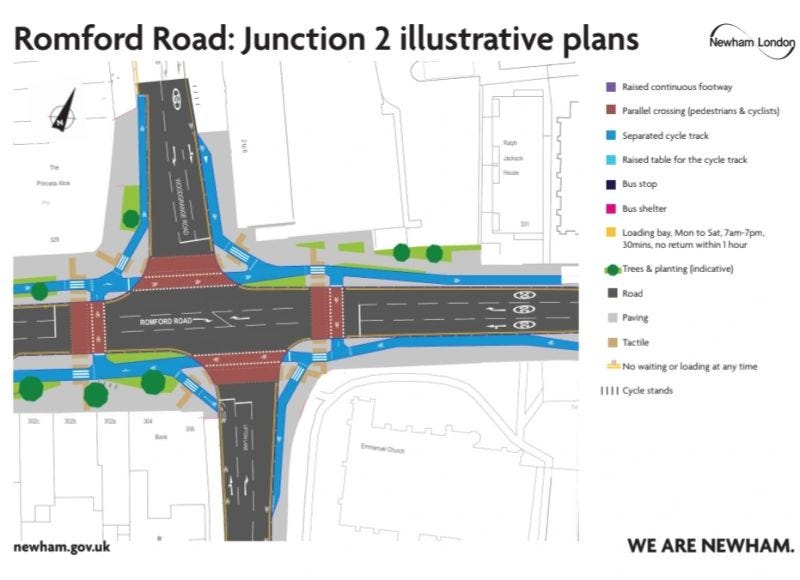
FROM DARLINGTON TO STRATFORD. Local authorities are quietly getting on with helping people cyle to work, to the shops, to caring duties, to their social lives, etc., etc. In Darlington, work is getting underway on Monday on the latest section of one the Tees Valley’s priority cycle routes. In east London, a crossroads on the formidable Romford Road is soon to be transformed into Newham’s first Dutch-style protected junction, as part of an ambitious wider scheme running east-west from Stratford to the North Circular.
INTERESTING GRAPH OF THE WEEK:
A Dutch-style junction. As the name suggests, these are common in the Netherlands, making it safer for those walking and cycling to cross, while trimming excess road space, which slows down drivers. As shared by Newham councillor John Morris, who hails his officer colleagues for making history in the borough with these plans.
ACTIVE TRAVEL WORD OF THE WEEK:
Soccer streets. A great way to rebrand the rethinking of public space, around a global event that people of all ages have enjoyed. Opening up the street as a space for celebration, rather than predominantly for cars, has started some great conversations in the US and Canada. Olé!
Until next time,
Adam Tranter
CEO, Fusion & Founder, #BikeIsBest
This newsletter is brought to you by Fusion, the agency for movers, specialising in communications and public affairs for active travel and mobility.

