


Every few years, a technology company promises to fix our cities, and every few years, we discover it has made them worse. Uber said it would cut congestion and became the single biggest driver of it. The Boring Company promised to move tens of thousands of people an hour and moves a few hundred. The pattern is reliable enough that you can spot the next one coming. This time, it is arriving on the pavement, in the form of delivery robots. They are already operating in British cities, at the expense of pedestrians, despite there being no law that permits their use.
Technology has always promised to revolutionise cities. But, when it comes to transport, the solutions experts agree on are typically solutions we’ve had since the mid to late-1800s. If you want to reduce emissions, improve efficiency and decrease congestion, then you need trains, trams, buses, and metro systems - not to forget walking and cycling. These are the proven methods for carrying large numbers of people, both efficiently and sustainably.
The motor car is, of course, also an impactful innovation when used in the right context. It is possibly the clearest example of a lobby being able to convince cities they should adopt a future of an individualistic private transport system that was neither technically possible nor desirable.
Cars proceeded to destroy cities. In many cases, literally. My home city of Coventry was famously bombed by the Luftwaffe during World War II, destroying much of its medieval core. But the planners had already decided to do it anyway - to make way for the motor car - and were even quoted as saying that it helped them accelerate the process. As former West Midlands Cycling & Walking Commissioner, I can speak with experience: it is taking a lot of time and a lot of money to put things right as cities realise the private car experiment has not worked.
I am not anti-technology; an electric bicycle has transformed my daily transport and I hope for the day when satellite internet makes its way to train travel, significantly improving productivity. Some technological improvements are welcomed, but they have to be implemented on top of sturdy foundations.
A helpful question to ask is: What problem are we trying to solve? A second question might be: What are the benefits and disbenefits?
With technology, we always seem to forget to talk about the latter. New tech blindsides us and somehow manages to sidestep even the most basic of scrutiny.
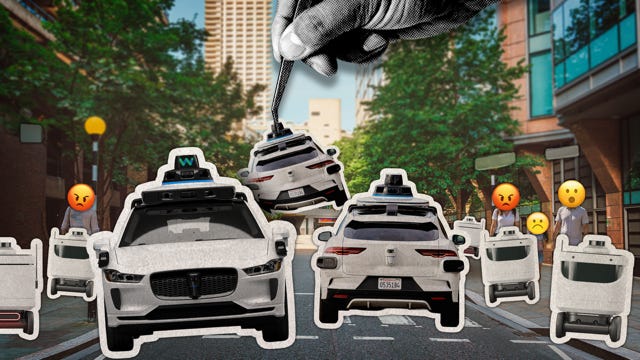
Two current big moves in transport, which have captured the imagination of the Government but in my view have significant disbenefits, are so-called “robotaxis” and pavement delivery robots. These follow a trend of trying to individualise transport, which, because of space constraints, makes no sense in cities, unless your only motive is profit.
We will discuss the disbenefits of these devices later and the impact they will have on an urban transport system. But first, we should look at what recent history tells us about whether improvements in this era of “individualistic incrementalism” have lived up to their promises.
We have a good example in Uber. Its promise to cities was that they would help reduce congestion. To the surprise of almost no-one who understands transport in cities, they did not. In San Francisco, ride-hailing vehicles were the single biggest contributor to congestion growth between 2010 and 2016, outweighing population growth, employment growth and road network changes combined. Vehicle hours of delay rose 62% with ride-hailing present, versus a modelled 22% in a counterfactual with no ride-hailing vehicles. In other words, they roughly tripled the growth in delay. Roughly 40% of ride-hail miles are driven with no passenger, between fares. 2020 analysis found a typical ride-hail trip generates about 69% more climate pollution than the trip it displaces, precisely because of these empty miles plus mode shift away from transit and active travel.
In London, private hire driver licences jumped from around 67,000 in 2013 to nearly 118,000 at their 2017 peak, and number is close to 109,000 today.
I am not particularly shocked that a tech company that stood to make maximum profit from flooding a market and individualising transport in cities, were not quite honest about the disbenefits.
Politicians, in particular, seem particularly susceptible to believing the promises of big tech. From 2016–17, Elon Musk pitched The Boring Company as a way to “solve” soul-destroying traffic. The original concept was autonomous electric “skates” running at up to 150 mph carrying 8 to 16 people, and the Vegas Loop is still marketed at an eventual 90,000 passengers per hour.
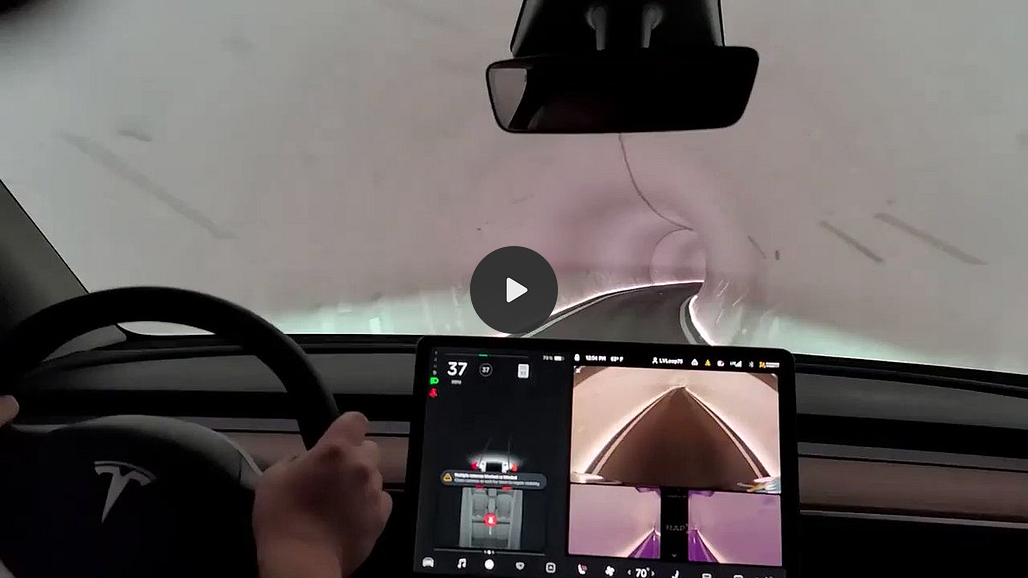
The reality? The only operational system is the Las Vegas Loop: human-driven Teslas, maximum four passengers, running through tunnels at around 35mph. Peak measured throughput on the original Convention Center loop was about 1,355 passengers per hour in 2021, against a contractual 4,400 the company was meant to hit, and a headline pitch of tens of thousands.

It cannot work for that awkward efficiency reason again: a single lane of cars moves on the order of 1,000 to 2,000 people per hour whether that lane is on the surface, elevated or bored through rock. A metro line on a single track moves 20,000 to 40,000-plus. But this hasn’t stopped politicians from believing the hype (aided by millions of pounds of lobbying dollars) and letting him build the thing.
Not all politicians are buying the arguments from the tech bros, though. Zohran Mamdani declined to renew the licence for Waymo in New York. Sadiq Khan’s TfL may do the same and refuse to licence robotaxi firms Waymo and Wayve in London, citing concerns about congestion and job losses. Congestion, as we saw with Uber in London, is a significant disbenefit that risks undermining public transport and active travel use. Even Elon Musk has said this quiet part out loud. In 2022, he tweeted: “Self-driving car[s] will amplify traffic to insane levels, as you won’t feel the pain of driving yourself.”
Supporters of Robotaxis have a strong card to play, and it deserves to be taken seriously: safety. The pitch is that a computer cannot drink, cannot text, and cannot lose its temper, and on the industry’s own numbers, that bears out. Waymo says its vehicles are involved in thirteen times fewer serious-injury crashes than human drivers across more than 170 million miles, and CNN’s review of the 1,200 collisions the company reported to American regulators found it was rarely at fault.
If the only question were whether a robotaxi is safer per mile than the average tired or distracted human, the honest answer will probably be yes.
But that is where the scrutiny usually stops, and it is precisely the wrong place to stop, especially if you care about sustainable transport in cities. The current data is the industry’s own homework; there is no requirement to report near misses, so the close calls never make it into the figures the companies are so keen to quote. CNN assembled them by hand from complaint lines, police reports and social media: a wheelchair user nearly side-swiped, a Waymo stopping a foot short of a schoolchild after ignoring a crossing guard, a father who had to push his son out of the road. None of that shows up in a collision statistic, and a former adviser to America’s road safety regulator summed up the direction of travel bluntly. As these cars gain market share in more cities, he said, we see more and more problems.
Then there is the promise the whole thing rests on, that machines obey the rules. But, demonstrably, they do not.
Active travel advocates inclined to support driverless car companies may be interested in a case from San Francisco, where Waymos are said to pull into cycle lanes to drop off passengers. There is now a lawsuit from a cyclist left with brain and spinal injuries after being doored by one. The San Francisco Bicycle Coalition says the company told safe-streets advocates that avoiding bike lanes was “too high a bar”, because customers want to be dropped off in them. Closer to home, a Wayve prototype ran a red light on Parliament Square while carrying the firm’s own chief executive to collect his OBE, a clip he then shared online to praise its “impressive drive without intervention”.
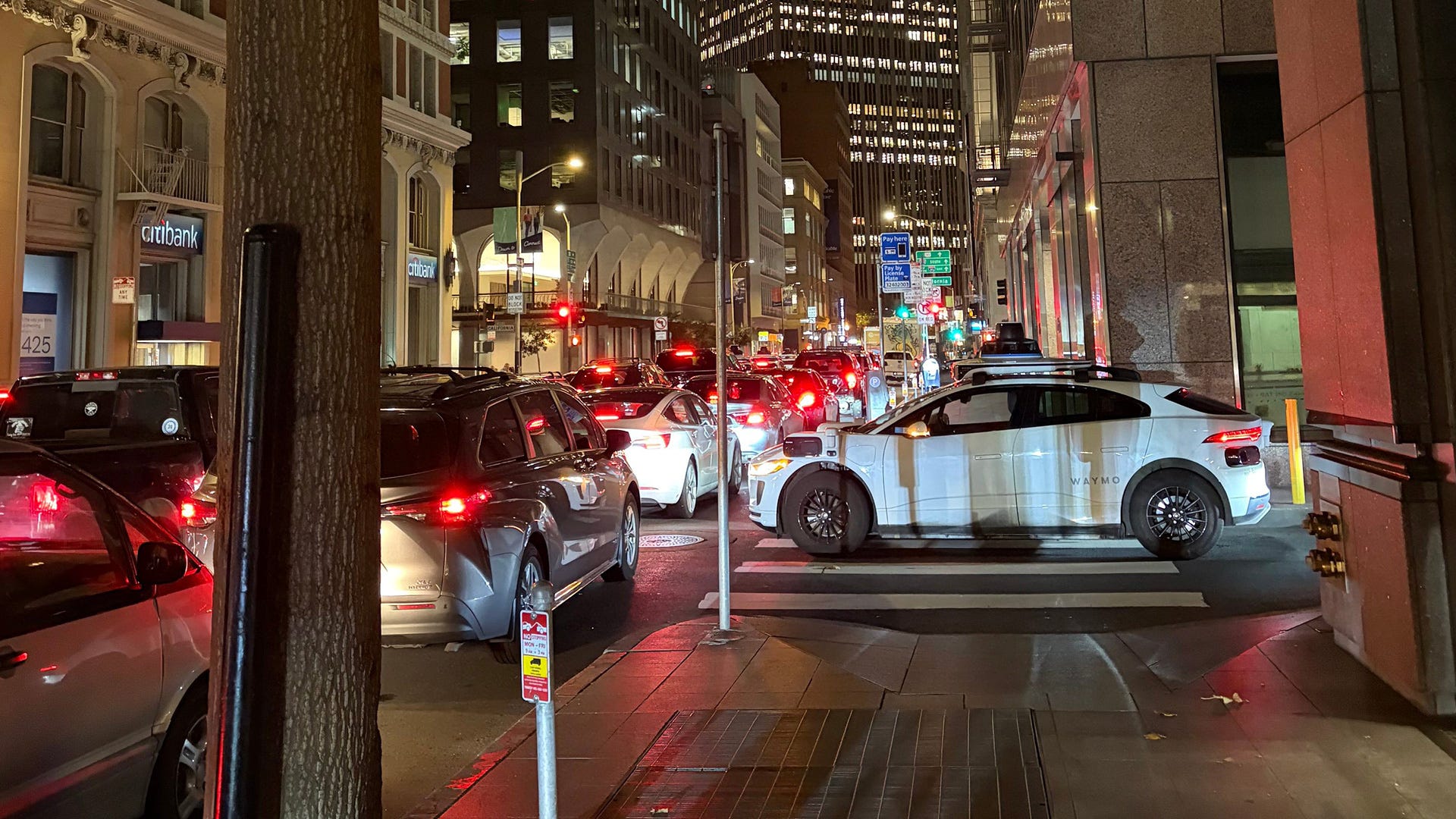
Robotaxis may improve the lives of some disabled people but they could also make things more difficult for other disabled people. Lobbying materials would like you to think their impact will only be positive. But given that disabled people are not a homogeneous group, this needs to be carefully scrutinised. A video from San Francisco shows a Waymo vehicle blocking side road zebra crossings as a result of being programmed to be more aggressive so other humans yield, letting them join the queuing traffic.
The lessons of technology’s overpromises should be learned. Unfortunately, self-driving cars look like they will be accepted onto UK roads, despite the issues. But there’s still a type of tech I feel that we can still stop: pavement delivery robots.
So apply the two questions one last time. What problem are we actually solving? Not a transport one. Zero-carbon last-mile delivery is already possible with bicycles and e-bikes, but the issue for tech companies is that it requires human labour.
Now the people with the least room to give it up are penalised: wheelchair users, those with sight loss, older people, anyone pushing a pram on a pavement, sharing limited space with robots. These are the disbenefits we’ve been failing to talk about.
This is why I have worked on a campaign “Pavement Overload” with the charity for everyday walking, Living Streets, where I am a Trustee.
If you’ve read this far, you’ll know not to trust big tech companies. But, in case you still need convincing, these machines are already trundling along British pavements with no law that actually permits them to be there. One of the big players, Starship Technologies, told The Grocer that “the Highways Act 1835 - which does not allow carriages to operate on pavements - creates uncertainty that could hinder investment.”
According to The Grocer, Starship have promised to build 10,000 robots in the UK if the government acts to clarify new legislation. The Government appears to be more concerned with a risk to inward investment than to pedestrians, so is planning a new Low-speed Zero Emission Vehicle category to regulate micromobility vehicles, including pavement robots, when Parliamentary time allows. Lord Hendy confirmed in answer to a written question from Lord Berkeley that “the Government recognises the current legal framework does not provide the certainty businesses need to invest.”
A lack of regulation hasn’t seemed to stop the companies responsible for the robots, which doesn’t bode well if you want to believe they will be additive to our communities. Starship Technologies and their rivals appear to be operating the same “act now, beg for forgiveness later” modus operandi as many other tech companies that exploit gaps in regulation. An FOI request from Bristol City Council, where Delivers.ai robots operate in partnership with Just Eat, is doing so without any permissions whatsoever: “There has been no approval process to permit delivery robots to be operated in Bristol. We are not involved in a pilot scheme, no licences, permits or agreements have been issued, no risk assessments have been undertaken, and no conditions or restrictions have been placed on operators.” A report in the BBC highlights the issue with robots narrowly missing a Councillor’s dog.
Pavements are some of the last spaces technically still dedicated to people (when not filled with badly parked cars and wheelie bins) and this is worth protecting. We know what we need to do to fix our problems in urban transport and they definitely involve more walking, more cycling and more public transport. The privatisation of public space, in many forms, has left us poorer as a society over time.
Then there’s the small issue that these robots aren’t even very useful. Many videos online show them needing human intervention, to have buttons pressed for them, or to be helped up kerbs. Some users online report that they’re slower than human delivery riders. All this, at the expense of vulnerable pedestrians, for what?
I believe that Britain’s pavements should not be for sale, and unlike the driverless car or the robotaxi, this is a fight we can probably still win before it becomes entrenched. If you think the footway belongs to people rather than private interests, add your voice and tell the Government: our pavements are not for sale.
Tell your MP and support the campaign at pavementoverload.com.

It's such a pattern that cities and governments become so excited by the new tech solution, and apparently fearful of being left behind, that they throw caution to the wind and just say yes, without apparently stopping to think. important campaign!
Great article that’s radicalised me from previously agnostic on these robots.
But question. Does this make floating cycle companies like Lime etc the good guys when it comes to mobility tech?