This week, yet more people are choosing cycling over driving for short trips - though the trend is not shared equally between men and women. There’s a deep dive into Low Traffic Neighbourhoods, some international comparisons of city cycling rates pre- and post-Covid, and a new bridge opening soon.
BIG STORIES FOR CYCLING ADVOCACY
WALKING AND CYCLING REPLACE CAR TRIPS. As fuel prices rise, so does active travel, but women could be left behind, according to research by Cycling UK. In a YouGov survey of more than 2000 adults, almost 30% of drivers are walking or cycling more - and 15% more are considering it. However, more women than men are considering cutting back on leisure activities or trips to green space. Most stark is the fact 7% of women had bought a new bike in response to fuel prices vs 13% of men. Cycling UK says financial support to buy bikes, as well as safer roads and tax incentives are needed to correct this inequality.
HOW TO GET RIDING AGAIN. This thoughtful piece - one of a growing number to help people get back on a bike as fuel costs rise - tackles motivational issues and the kinds of thoughts that might deter someone from getting on a bike. Tips include cycling part of the journey, rather than all the way; storing the bike somewhere accessible at home; and forgetting preconceptions of what a ‘proper cyclist’ might be. It also suggests online maintenance videos to help keep maintenance costs down. The links relate to Australia but the template is a good one.
LONDON’S MOST CONTROVERSIAL STREET? If a brief video about the history of Low Traffic Neighbourhoods sounds like your bag, well, you’re in luck. The title is grabby but, luckily, the content is also good. Its presenter, Evan Edinger, looks at the recent Tower Hamlets LTN court battle through a wider lens. He pans back as far as the 1970s where nearby De Beauvoir town in Hackney was similarly ‘filtered’ to through running traffic after drivers hit a lollipop lady and a child, sparking protests. As with today’s measures, collisions dropped dramatically. Improvements, however, aren’t a guarantee of a scheme’s safety. Today’s communities sometimes have to fight for change, just like those in the 1970s. Worth a watch.
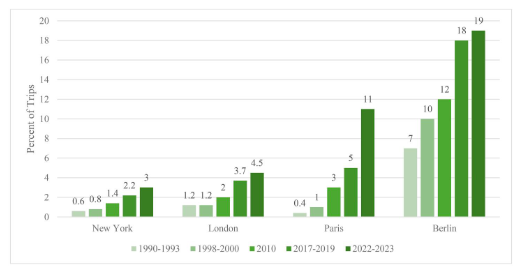
A TALE OF FOUR CITIES. Research looked at cycling in London, Berlin, Paris and New York, pre and post-Pandemic. All four cities initiated COVID-era cycling infrastructure, and have continued expanding cycle networks since. All four differ in density, climate and makeup and car-ownership status of residents. As a result, their cycling outcomes differ. Cycling rates rose most dramatically in Berlin over the period, with Paris second - and while safety improved in Paris and Berlin, post-pandemic, in New York and London it stagnated. The report authors note cycling improvements haven’t been felt evenly, with inequalities on access persisting - and there’s gaps in the networks. There’s also the risk of political shifts that reverse support for active travel, as in Berlin where speed limit reductions have been reversed, post-pandemic.
SPEEDING = FINES. It may seem obvious in the road safety community, but more drivers speeding would tend to mean more drivers being penalised for speeding. It’s worth pointing out, though, that countering the ‘cash cow drivers’ narrative often surrounding speed limit enforcement. The BBC’s Holly Hamilton has done just that, via FOI data obtained by IAM RoadSmart around speeding-related penalty points. This data suggests people are breaking speed limits more regularly, while camera technology has improved detection.
OTHER HEADLINES
NOTTINGHAM’S NEW BRIDGE OPENS SOON. A new walking and cycling bridge connecting Trent Basin and Lady Bay in Nottingham will open to the public on 2 June. Bridges are crucial for local active journeys, saving people potentially miles of detours, and hills. As mentioned in November (#188), the bridge will connect a regenerating Trent Basin area, with its new homes and schools, and the Lady Bay/West Bridgford area with their sports facilities, including Trent Bridge cricket ground. Local people, including cycle campaigners, Pedals, have been asking for the bridge for the past 12 years, apparently. The new bridge will connect to local cycle networks and the NCN.
INTERESTING GRAPH OF THE WEEK: Cycling growth in four major cities, pre- and post-Covid. Those who invest in routes reap the cycling rewards. Source: https://www.tandfonline.com/doi/epdf/10.1080/15568318.2026.2649315?needAccess=true
ACTIVE TRAVEL WORD OF THE WEEK:
Stopping distances. Slower speeds reduce the kinetic energy of a vehicle, in a collision, increasing survival rates. However, they also reduce stopping distances, reducing the likelihood of collision in the first place. At 30mph, it takes around 11m longer for a driver to stop - around three car lengths - than at 20mph.
Until next time,
Adam Tranter
CEO, Fusion & Founder, #BikeIsBest
This newsletter is brought to you by Fusion, the agency for movers, specialising in communications and public affairs for active travel and mobility.