


This week, delivery companies are still wreaking havoc again in our cities. Meanwhile, the era of the sports car is on the wane – though the dominance of its larger SUV cousin is definitely not. And while we think of pavements as safe havens, they are an increasingly contested space, with real consequences for the most vulnerable users.
BIG STORIES FOR CYCLING ADVOCACY
TIMES HAVE CHANGED. That’s the prosaic version of this entertaining read by the Times’ Giles Coren who looks back on his dad’s generation, at their prime in the 1970s, and the promise of freedom driving offered. His trip down memory lane recalls the machismo that was tied in with soft top cars half a century ago, not least for his own father. As sales of topless cars declines, he reflects on wider changes in how we travel. Young people, he reflects, not only don’t want soft top cars, they don’t want to own cars at all. Those who rail against those changes, he argues, live in the past. Well worth a read.
THE TIMES HAVE CHANGED. The Times, which once ran a campaign to make cycling safer in cities after one of their journalists, Mary Bowers, suffered life-changing injuries in a collision with a heavy goods vehicle. Their official editorial opinion, published this week, forgets much of that and instead focuses on tropes such as there being “a powerful cycling lobby” and that a solution would be to affix licence plates; the only country to do this in modern times is North Korea.
WHERE DID FAMILY CARS GO? That’s what the Guardian’s Coco Khan asks in this piece, with a brilliant Batman reference thrown in for good measure. In the search for a family car, Khan has realised there are no (or few) cars in the secondhand market; it’s all SUVs. She points out these oversized vehicles now make up 30% of cars on the road and half of all new car sales in rich countries, making this trickle-down into the used car market inevitable. Taking aim at the needlessly combative language deployed in their marketing, along with the unnecessary arms race they are creating on the roads, with a good dollop of humour, it’s another excellent read.
PAVEMENT PERIL. For all the – understandable – concern over e-scooters and e-bikes on pavements, an often-overlooked harm is from drivers who stray onto footways. Analyst Blaise Kelly has looked at this topic in recent months; the latest collision (STATS19) data shows the majority of pavement injury collisions involved motor vehicles, and the numbers have increased in the past five years. The solution, he asserts, is to address the physics behind the problem: the speed of vehicles – and to contextualise the problem of e-scooters and cycles on pavements with the greater harm caused by often overpowered and oversized vehicles, something few of us truly grasp.
ROBOT PAVEMENT INVASION. Our pavements are already contested spaces. Already too often poorly serving modern needs, the situation has only worsened in recent years, by the encroachment of vehicles. Permission for delivery robots to operate on footways by the UK government is another assault on that precarious space. And while delivery companies insist the robots behave themselves, videos of them blocking pedestrians abound online, as Ed Wisement puts it in his Unherd piece. With some weighing over 50kg, the kinetic energy of these machines is formidable, despite the cutesy branding intended to endear the menaces to humans.
DELIVERY DRIVERS’ DESPERATION. Delivery riders for Deliveroo, Uber Eats and Just Eat have been found by the Daily Mail to be living in illegal shanty settlements, sleeping in tents on the street. Riders can earn shockingly low sums working 10-12 hour shifts on the streets of cities around the UK, not least in London where the report comes from. One rider says he stopped delivery riding because he found he could make more money begging on the streets. This is an outrageous exploitation of workers (who aren’t allowed to be legally described as workers because they are freelance contractors).
OTHER HEADLINES
LISBON BIKE SHARE PAIN. Lisbon’s Gira bikes are ubiquitous in the city. Cheap to use and with widespread coverage, they nonetheless can be a thorn in the city’s side. The municipal-run docked cycle share scheme is notoriously poorly maintained, with a glitchy app that makes its use a daily frustration for those who rely on it. The city council has reported more than 700 acts of ‘vandalism’ this year, adding to a lifetime cost for replacement and repair of parts, of €3m.
INTERESTING GRAPH OF THE WEEK: Pavement safety debates can often head straight to the issue of bikes or scooters on footways. However, often overlooked is the far greater risk drivers cause pedestrians on pavements.
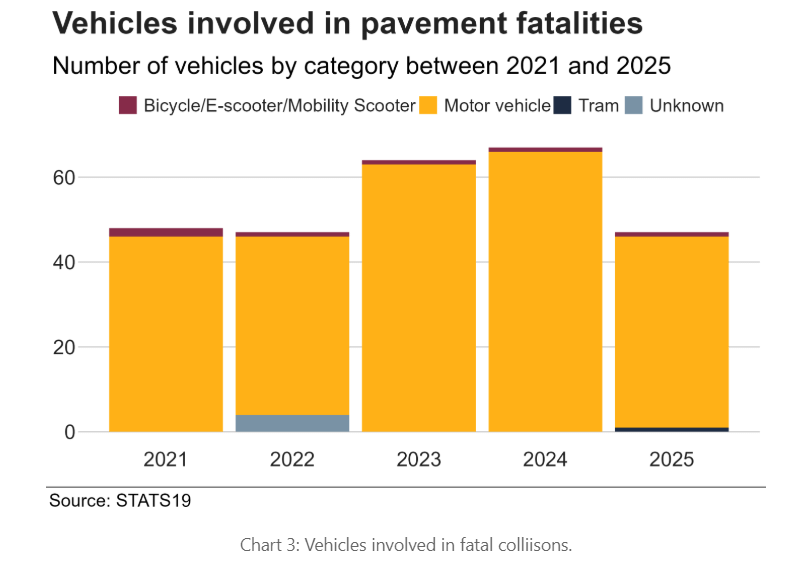
Source: Blaise Kelly on LinkedIn.
ACTIVE TRAVEL WORD OF THE WEEK: Footway. A walkway or path for the use of pedestrians. While footways come in different shapes and sizes, their purpose is to provide a clear and safe route for those on foot and, of course, wheeling using a mobility device.
Until next time,
Adam Tranter
CEO, Fusion & Founder, #BikeIsBest
This newsletter is brought to you by Fusion, the agency for movers, specialising in communications and public affairs for active travel and mobility.
