


This week, I was struck by something Chris Boardman said (link below to his new Substack) about what happens between the places we are coming from and the ones we’re going to. These spaces might range from a roaring urban freeway to a sanitised and uninspiring pedestrianised square. To work, these places need to consider who is using them, whose experiences they enable and whose they limit. Wouldn’t it be great if we started thinking this way?
BIG STORIES FOR CYCLING ADVOCACY
LTNS FOR NYC. Unchecked through-traffic blights neighbourhoods around the world, increasing danger to pedestrians and cyclists, and generating noise and air pollution. New York Mayor Mamdani’s transportation department is set to tackle this problem at a collision hotspot in the Greenpoint neighbourhood. Two ‘diverters’ will send drivers on opposing L-shaped trajectories through a key junction, creating a Low Traffic Neighbourhood effect, along with two new pedestrian crossings and the closure of a pair of slip lanes to traffic. It’s another bold move for this administration, and cities around the world may well watch the results with interest.
THE ELEPHANT IN THE ROOM. During a walkabout and a public meeting with Steve Coogan (yes that Steve Coogan) in Middleton, Chris Boardman thinks about the town with a proud industrial heritage but a rather forlorn present identity. Town planning has too often centred around moving people through a space quickly - often in cars - or presenting a sanitised space with all the right ingredients but nothing particularly attractive as a place to spend time. Describing it as the ‘elephant in the room,’ in his new Substack, Boardman describes a locally-driven solution, of hearing residents’ needs and preferences, and forging a way forward from there.
OTHER CITIES TURNING ELEPHANTS AROUND. Public baths, parks, food growing and seating: just some things city architects around the world have created from car parking spaces. The European Prize for Urban Public Space has shortlisted architecture that converts car spaces into heatwave-busting places for people. One roundabout in the Northern Spanish town of Logrono was temporarily converted into a shaded bathing pool, while a huge car park in Antwerp is now a park generously dotted with trees. Architects speak to the Guardian about the challenges of reversing entrenched car-centric thinking, but the results are clearly popular.
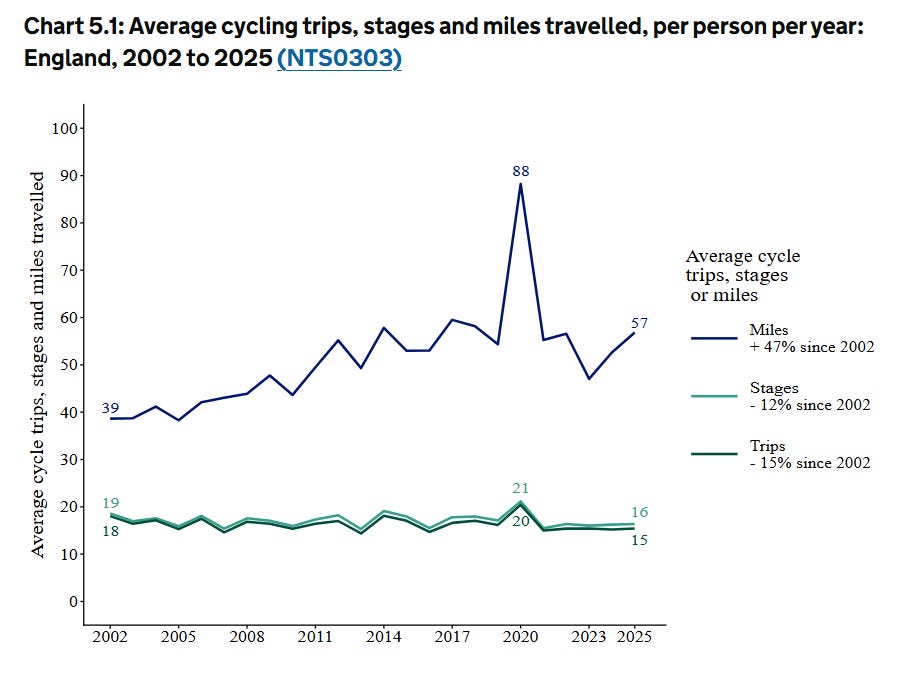
NATIONAL TRAVEL SURVEY RESULTS. Little seems to have changed, England-wide, in walking and cycling terms in the past ten years. According to the latest National Travel Survey, released last week, 2025 seems an unremarkable year. Cycling journeys are still around 2% of trips, although people are cycling longer distances. Meanwhile, walking trips seem similarly stubborn, at 29% of trips, and 33% of stages. Men still make more cycling trips than women (22 vs 9), and travel further each year (83 miles vs 30 miles), while women tend to walk more often and further than men. While there’s pockets of improvement, there are also large areas where change is slow to the point of stagnation.
NETWORK RAIL E-BIKE BAN SCARE. In a torrid few months for the e-bike industry, news last week of a potential ban was a low point. A ‘security note’ spotted at Leeds Station said e-bikes were not permitted on Network Rail property. After a great deal of concern among passengers, many of whom rely on electric cycles to commute, and fear among the industry, the sign was removed. However, it perhaps speaks to underlying confusion, even among transport professionals, around the difference between safe, legal e-cycles and illegal e-motorcycles, which fail to meet fire safety standards. E-Bike Positive is an important step - and needs broad uptake.
OTHER HEADLINES
BE MORE DANISH. If our daily lives are governed by the spaces in between, it’s no wonder the Danish are getting it right. This piece in The Conversation compares a typical day in the life of a Danish person vs a British person, as a way of explaining Denmark’s longer, healthier lives, with higher levels of wellbeing. It finds that while our days are largely the same, there are a few key differences that impact health. By cycling to work in greater numbers, exercise is built into Danes’ days, it finds - dedicating a substantial part of the piece to the impact of this inbuilt activity. A policy choice to build cycle routes has reaped population-wide benefits, along with shorter working weeks, and state-funded childcare that enables a better work-life balance.
LIME RIDER BANNED AND FINED. A careless Lime rider has been banned from the platform and fined by Police after City of London Police used CCTV and rider data provided by Lime to trace him. Police are working with Lime to catch anti-social cycling offences and potentially helping the force tackle wider offences in the future.
INTERESTING GRAPH OF THE WEEK: How much England is cycling. Source: https://www.gov.uk/government/statistics/national-travel-survey-2025/nts-2025-active-travel
ACTIVE TRAVEL WORD OF THE WEEK:
Bottom-up regeneration. As opposed to top-down. Long understood as a desirable way to make change, it’s a challenge to translate what people want to improvements on the ground, but one that’s surely worth taking on.
Until next time,
Adam Tranter
CEO, Fusion & Founder, #BikeIsBest
This newsletter is brought to you by Fusion, the agency for movers, specialising in communications and public affairs for active travel and mobility.

