


This week, car dependency rears its head: we take a look at how it happens, what the impacts are and how and why we should do better. Car dependency is expensive, bad for our health, bad for our communities and fully embedded into some of our communities, with devastating impacts for people’s physical, mental and financial wellbeing. We can do better, but it’s about making the right choices when we build streets, communities and, yes, New Towns.
BIG STORIES FOR CYCLING ADVOCACY
MAN SOLVES CYCLE MAPPING PROBLEM? The ability to navigate a city by bike means people need to know where is safe, and where isn’t safe to ride. Many have tried to solve the problem, with mixed results. In London, one man has spent an estimated 3,000 hours producing a map that’s hailed a success. Aydin Crouch’s SafeCycleLDN map, which has the backing of the London Cycling Campaign, was produced after a lot of cycling around the city, use of Google Maps and tips from other riders. It’s been used 1,3000,000 times since 2021, most of those in the last year. Sadly it’s not available more widely.
CAR-LESS HOME FACES £800 A MONTH TAXI BILLS. A report on life in Milton Keynes has lessons for the rest of the UK. It found households in the most deprived areas are forced to rely on taxis to work, to access affordable shopping and even to travel three miles to school, the latter costing £800 a month. While newer homes on the outskirts of towns offer lower heating bills, no-one seems to have thought about the embedded transport costs of car-centric developments far from amenities that lack a decent bus service, or walking and cycling links. And despite planned investment in big transport projects in Milton Keynes, significant transport deserts remain.
SHIP SHAPE AND BRISTOL DECLARATION. Transport and health professionals have joined forces to urge the government to recognise transport’s public health role - and to make the relationship a positive one. The Bristol Declaration calls to recognise “car dependency as a public health issue”, and the need to shift towards walking, cycling and public transport. It seeks measures like 20mph speed limits in built-up areas, cycling, walking and wheeling access to new homes, and a per capita active travel spending of £35. Road transport pollution contributes to strokes, heart disease, diabetes, dementia and cancer, on top of the toll of road collisions.
WHY PEOPLE CHOOSE NOT TO DRIVE. New research by the Department for Transport examines why people choose ‘multi-modal travel’, including public transport, rather than driving. Unsurprisingly convenience and cost were the top deciding factors. Convenience encompasses three things: time, effort and stress; while safety is important for the walking part of a trip. Oddly, this document doesn’t mention cycling once. It seems a significant oversight, given the government’s own cycle-rail guidance says cycling can increase the catchment area of a train station by 16 times, compared to walking.
JOURNEY ENDS FOR CARGO BIKE PIONEER. Pedal and Post, the Oxford-based cycle delivery firm and a pioneer in the field, has come to the end of its journey after 14 years, after losing a major client. However, its CEO, Christopher Benton, says it’s not the end for cargo bike logistics, and underlines the benefits of cleaner, more efficient cycles for urban deliveries. The firm’s recent expansion to London will also cease operations. At Fusion, we use Pedal Me for all our London deliveries; check them out.
OTHER HEADLINES
CYCLE PATHS OF EUROPE. Potentially one for the kerb nerds, but also a fun journey around some of the solutions different nations’ planners and engineers have come up with to help people cycle more. From Sweden to Portugal, Germany to Ireland, ‘Definitions for cycling infrastructure’ is also a quiet celebration of the collective efforts around the EU to give people healthy, affordable transport options. Though I’m not sure the advisory cycle lanes, or ‘pavements you’re allowed to cycle on’ would feel that safe or convenient in the UK.
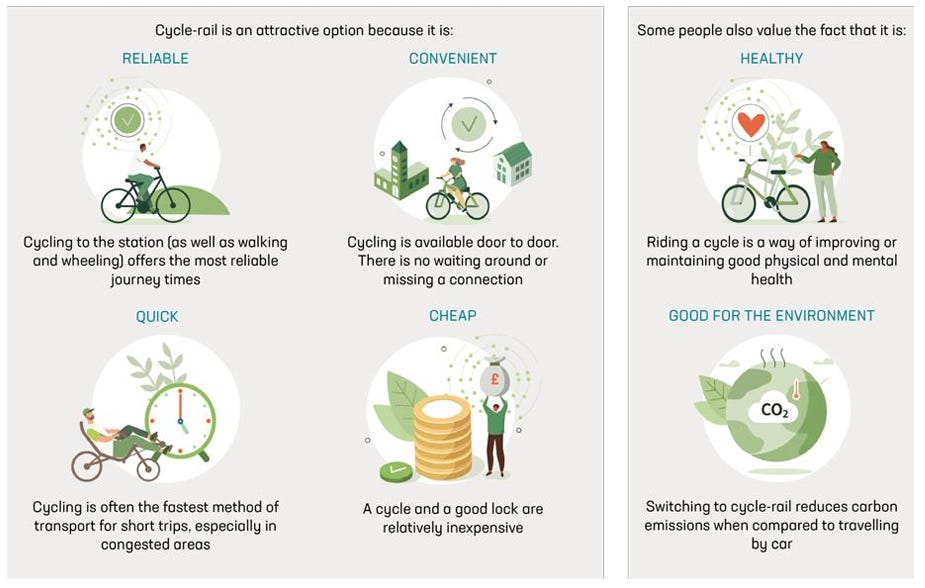
INTERESTING GRAPH OF THE WEEK: The benefits of cycle-rail links. Unsurprisingly, cost and convenience are two of the good reasons we should connect rail stations with cycling. Source.
ACTIVE TRAVEL WORD OF THE WEEK:
Multi-modal travel. A term we’re revisiting this week because it matters. While most of our trips are short, for those that aren’t, a well-planned cycling and walking route can make the difference between a 20 mile drive and a bike-train, walk-train or wheel-train journey. That’s great multi-modality.
Until next time,
Adam Tranter
CEO, Fusion & Founder, #BikeIsBest
This newsletter is brought to you by Fusion, the agency for movers, specialising in communications and public affairs for active travel and mobility.
We’re currently hiring for a Public Affairs Account Executive, if you’d like to work with me on active travel, the outdoors and mobility. More info.

Despite Google maps being the most popular navigation app, its cycling data is woefully inadequate.
There a errors and huge gaps in the data, meaning the routes suggested are rarely the best or even achievable. Not great if you’re new to cycling!
What’s worse is the difficulty in reporting errors or the opportunity to suggest improvements. While Apple Maps has similar limitations in the accuracy of the dataset, at least the reporting feature is much better!
Very interesting post thank you, I was particularly interested in the map, how does one best use it seems to download a layer into Google maps, can you use it to get directions or just as a map 🤔👍