


This week, we’ve got some fascinating studies around attitudes to driving, and cycling and walking streetspace changes, as well as a potentially exciting shakeup of laws impacting disabled cyclists. And even some bus stop bypass news.
BIG STORIES FOR CYCLING ADVOCACY
SUVS ADS AXED IN AMSTERDAM. Amsterdam has become the world’s first capital city to ban SUV ads in public spaces, along with other planet-harming products relating to fossil fuels, and even meat products. The legally-binding ban was passed, DeSmog reports, despite last-minute lobbying from advertising company JCDecaux and, of course, the companies selling products affected (the ban includes flights). These products, it has been argued, normalise planet-harming products and behaviours.
FLOAT ON BY… There’s new government guidance for floating bus stops this week - and Ranty Highwayman aka Mark Philpotts, expert engineer - has thoughts. While he concludes there’s lots of helpful nuance in the new guidance, there are also elements he considers unhelpful, like too-high kerbs between cycle lanes and pedestrian areas, which could cause ‘pedal strike’ and reduce the effective width of a route (i.e. the width riders will/can use for fear of hitting said kerb). There’s also the notion that cyclists need to be slowed down, which he says is an engineering solution to a wider road culture problem and could cause accessibility issues for non-standard cycle users.
DISCOURAGE DRIVING TO DISCOURAGE DRIVING. That’s the conclusion of a paper examining the impact of what’s known as ‘carrot’ vs ‘stick’ approaches to changing transport behaviours. Looking at patterns across a number of studies relating to car ownership and use, it found the biggest determinant of whether people drive, and their attitudes to driving, is whether they already drive. That’s not to say ‘soft’ measures aren’t valuable - the right measures can be powerful - but persuading people is unlikely to work alone. It has to be harder to drive, or more convenient to use alternatives, creating new habits. So things like parking controls, congestion pricing.
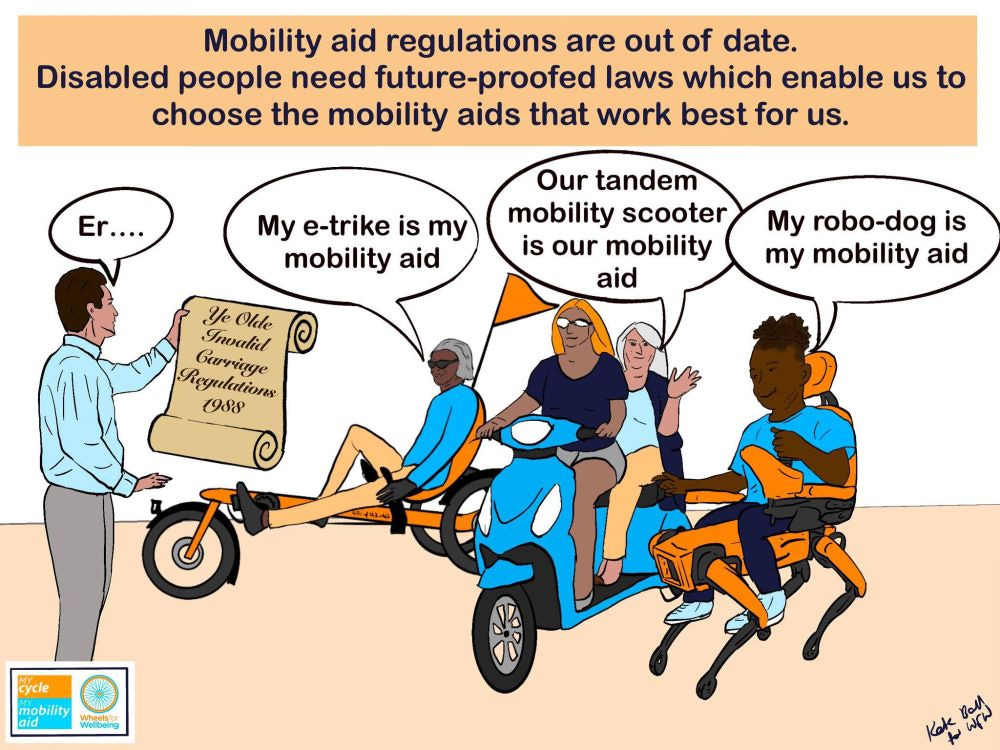
IMPORTANT MOBILITY AID SHAKEUP. The Department for Transport is currently consulting on 40-year-old legislation around powered mobility devices. Currently a number of potential mobility aids are legally restricted, including wheelchair weight, the use of e-scooters on public roads, and the e-cycle age limit. To that end, Disabled cycling charity, Wheels for Wellbeing, is hosting a series of webinars in early February to help inform people of the current regulations, and the wide ranging needs of the 10 million UK residents with mobility-related impairments.
PUBLIC EDUCATION STILL NEEDED. A number of Bicester residents have acted in a ‘vigilante’ fashion towards Disabled cyclists legitimately using a pedestrianised street. In November 2024 a 30-year-old cycling ban on Sheep Street was lifted, but the restriction remains during the Friday market - with a recent and welcome exemption for those using cycles as mobility aids. Such encounters can be horrific for Disabled cyclists, who already face a challenging transport landscape, and education of the general public, not least the individuals in Bicester, is urgently needed.
OTHER HEADLINES
MOST SOCIAL MEDIA CYCLING COMMENTS ARE POSITIVE. That’s what one recent study found, having analysed 36,696 UK tweets about cycle lanes and LTNs March 2018 - June 2022. The odd spike in negativity happened, including around the rollout of emergency cycle lanes in the summer of 2020. Concerns were from those who saw changes as an attack on their freedom to drive and whether or not people felt properly consulted, rather than the principle of schemes themselves. One researcher concluded: “Their concerns need to be acknowledged, but also reframed in light of the reality that limited road space must serve everyone: drivers, cyclists, and pedestrians alike.”
LABOUR MP PROPOSES BAN ON SALE OF '“MONSTER” E-BIKES AND DODGY E-BIKE KITS. This week, Parliament heard a proposal to pass legislation to ban the sale, marketing and supply of illegal e-bikes and powerful conversion kits from Julie Minns MP. While legal e-bikes are a force for good, the Chamber heard, online marketplaces and overseas suppliers often sell high-powered e-bikes and conversion kits with minimal checks, “scant” safety information and “no clear liability”. It is worth mentioning that between 2010 and 2024, only about five Ten Minute Rule Bills have become law.
INTERESTING GRAPH OF THE WEEK: Because January deserves one more cartoon that makes you chuckle while packing a punch. Ye Olde Invalid Carriage Regulations, as this graphic describes them, are far outdated for the modern needs, and the modern (and future) options, of disabled people. Source: https://wheelsforwellbeing.org.uk/our-campaigns/campaigning/mobility-aid-legal-changes-every-journey-everyone/
ACTIVE TRAVEL WORD OF THE WEEK:
Powered mobility devices: As Wheels for Wellbeing (WfW) puts it, “a mobility aid is any item which a Disabled person uses to help with moving about at or below walking speed”. There are a plethora of such powered devices, ranging from e-cycles and e-scooters, to electric wheelchairs, e-trikes and clip-on handcycle attachments for wheelchair users. At present the law is a bit of a mess, but there’s hope the current consultation will improve matters. WfW would like to see them regulated with LZEVs, lightweight zero emission electric vehicles, with the option to carry more than one person (see week 177).
NOTE - THIS EDITION WAS UPDATED ON 5 FEBRUARY TO CLARIFY THAT WHEELS FOR WELLBEING WANTS TO SEE MOBILITY DEVICES REGULATED WITH LZEV'S, RATHER THAN TERMED LZEVS.
Until next time,
Adam Tranter
CEO, Fusion & Founder, #BikeIsBest
This newsletter is brought to you by Fusion, the agency for movers, specialising in communications and public affairs for active travel and mobility.
We’re currently hiring for a Public Affairs Account Executive, if you’d like to work with me on active travel, the outdoors and mobility. More info.

Fantastic breakdown of Amsterdam's move here. That carrot-stick research finding about existing drivers being hardest to shift is kinda brutal but tracks with what I've seeen in local policy debates. Making alternatives easier only works when driving becomes proportionally less convenient, othrwise people just optimize both.
Congratulations to Amsterdam, yet another example of Dutch commonsense and pragmatism. It would be good if we in the UK would adopt similar policies, in addition to increased parking charges and road tax for oversized vehicles generally.
The piece about carrot and stick is also highly appropriate. The notion of promoting desirable behaviour while simultaneously discouraging undesirable behaviour, is far more effective than just offering little improvements here and there. It is unfortunately our innate desire in the UK to bend to populism, that continues to allow, and even encourage, undesirable behaviour. That in a nutshell explains why we see little if any real improvement in the UK, despite all the good efforts of this and other worthy campaigns.