


This week, induced demand is back in the spotlight. Best known as the phenomenon in which you build more roads, you get more car trips, it also applies to other modes of transport. So, if you build bike routes, you unlock demand; the same is true if you make cargo bikes available, or pavements better. Ultimately, we build what we care about, and too often we seem disproportionately fond of motor cars.
BIG STORIES FOR CYCLING ADVOCACY
INDUCED DEMAND STILL TRUE. “The core problem established… over 30 years ago still exists: building extra road capacity to solve congestion from increasing traffic is likely to induce extra road traffic, which receives benefits itself but causes additional delays and environmental costs to others.” That’s the one sentence summary of a new ‘think piece’ on the phenomenon of induced demand. The author, Phil Goodwin, highlights this phenomenon also exists for other transport modes. Build it and they will come is still true - and the “it” shapes our cities and lives.
E-MICROMOBILITY FOR THE SUBURBS. Cargo bike trials in three English city suburbs, along with national and local surveys, has assessed the potential for household use of e-micromobility (see word of the week) in more car-dependent places, including towns and rural areas. More than half of e-cargo bike miles ridden replaced car miles, research found. More than half of people in England would like to try an e-bike, e-cargo bike or e-scooter, while 11% already owned one. Stopping people doing so were concerns around road safety, cost and where to store the vehicles. Financing, try-before-you-buy and, of course, improving safe routes, would help.
54% OF WAYMO MILES DRIVEN ‘EMPTY’. A little over half of all miles (54%) travelled by driverless Waymo taxis in California carried a passenger. That’s according to data from the first thousand days of the service’s operation, since August 2023. With ‘robotaxis’ coming to cities around the world, we should be asking: what are these vehicles adding to the transport mix, and do the benefits outweigh the disbenefits? This analysis, published in Transport Findings, used data submitted to Californian officials, underlining the importance of such data in cities’ ability to assess these services’ impact on congestion - rather than simply being beguiled by the tech.
PUTTING PEDESTRIANS FIRST. Decades of policies, good intentions and, frankly, thousands of deaths, have failed to result in action to protect pedestrians. In two-pages, the well-respected Transport for Quality of Life sets out where we are with the walking realm, and how we get to where we keep saying we want to be, i.e. putting pedestrians first. It sets out seven actions, from reducing speed limits and banning pavement parking, to upping the frequency of pedestrian crossings. Calling putting pedestrians first ‘radical’ would be laughable, were it not for our long history of inaction.
NEW YORK FIRE DEPT (FDNY) SUPPORTS BIKE LANES. Emergency services can be weaponised against cycling infrastructure, with claims they block vehicle access when it’s most needed. In New York, individual firehouses and spokespeople have grumbled about them in the past. Now, however, the city’s fire commissioner, Lillian Bonsignore, is on record supporting bike lanes. While manoeuvring around them can be an issue, he said, “it’s our mission – our core mission, to save lives – and we appreciate the fact that bike lanes put people in a safer place and they save lives.” Emergency vehicles have even been filmed using them to get around the city’s notorious traffic jams (a good argument to build bike lanes nice and wide).
OTHER HEADLINES
JANETTE SADIK-KHAN BACK IN NYC TRANSIT ROLE? NYC Mayor Zohran Mamdani has nominated former transportation commissioner, Janette Sadik-Khan for the city’s transport board. If confirmed by the city senate she will, along with Melanie Hartzog, work on bringing affordable transport to more New Yorkers. JSK’s book, Streetfight, describes her time delivering pop-up pedestrian plazas and bike lanes across the city in 2008 - almost two decades ago. It’s what inspired me to be more involved in advocacy and ultimately, take the role as West Midlands Cycling & Waking Commissioner. If you haven’t read it, it’s an amazing account of some quite pioneering work that cities like Paris have mimicked since, with great success.
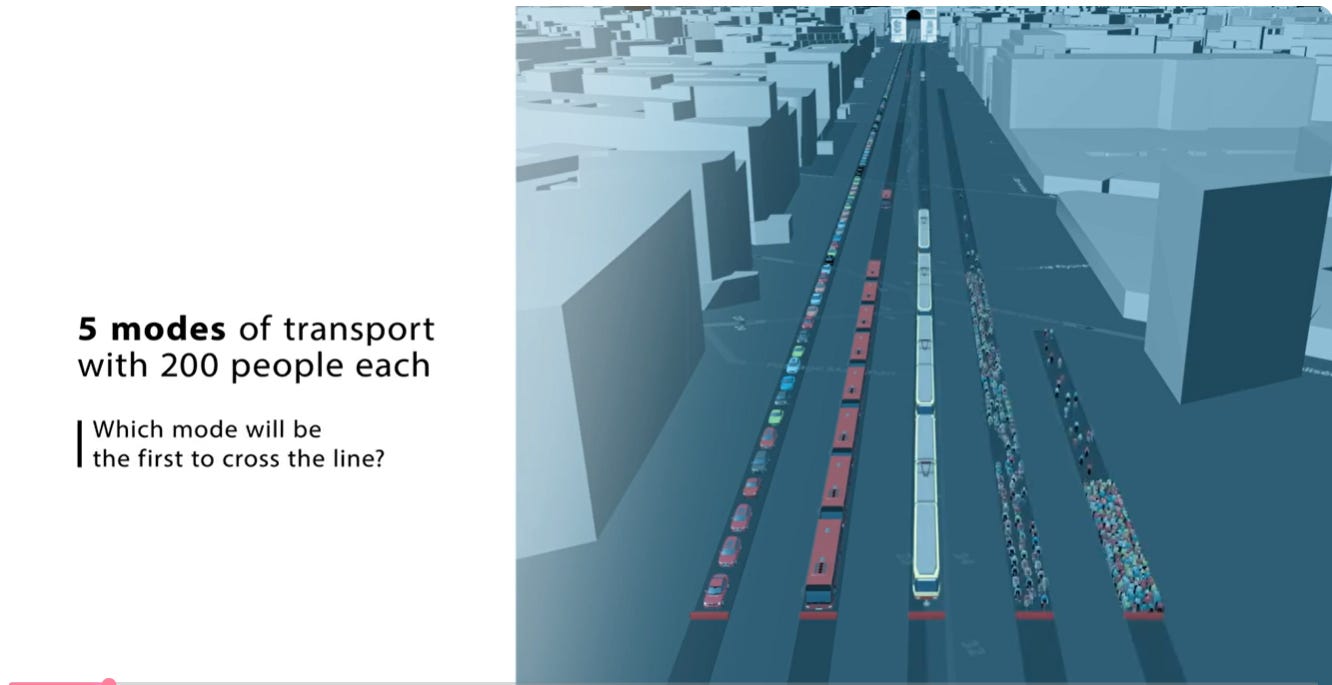
INTERESTING GRAPH OF THE WEEK: Streets should be about moving people, not just cars, and this graphic is a re-hashing of an old classic, showing just how efficient, or inefficient, different modes are. Carrying 200 people in private vehicles uses 1030m of road space (1.5 people in 133 cars), vs 27.6m for pedestrians. Of course, this simulation is not in the real world, and I’m not convinced the drivers and cyclists would necessarily be going at the same pace, but it’s a fun exercise. You can watch the video to find out who crosses the line first, here:
ACTIVE TRAVEL WORD OF THE WEEK:
E- Micromobility. An urbanist term encompassing electrified transport modes like e-cycles, e-cargo cycles and e-scooters. Differentiated from e-mobility, of course, by size.
Until next time,
Adam Tranter
CEO, Fusion & Founder, #BikeIsBest
This newsletter is brought to you by Fusion, the agency for movers, specialising in communications and public affairs for active travel and mobility.
