


This week, I’ve been in Rimini, Italy, for Velo-City, the annual global cycling conference - where world leaders in active travel get together to learn from each other and celebrate the power of cycling. Back in England, there’s the third Cycling and Walking Investment Strategy (CWIS3) to delve into. Plus, we ask is cycling left-wing, or right-wing? Or both?
BIG STORIES FOR CYCLING ADVOCACY
CWIS3 - THIS TIME THERE’S TARGETS. The long-awaited third Cycling and Walking Investment Strategy (CWIS3), launched last week, is better than its consultation suggested, with measurable targets for walking and cycling stages, and a commitment to map a genuine national network by 2030. This refresh is badly needed, following the failure of CWIS2: 1.0 billion cycling stages were made in 2024 against a target of 1.6 billion by 2025, while cycling among 17-29 year-olds actually fell. Walking missed its target too, with under-16s walking less. CWIS3’s focus on young people is welcome, as is the return of the HS2 Cycleway. Concerns remain around the £4.5bn headline, a projected investment over five years, not ring-fenced money. Its success will all come down to whether delivery matches the rhetoric.
CYCLING: NOT JUST FOR THE LEFT. It has always puzzled me that politicians on the right, who want a smaller state and less regulation, seem to want more bureaucracy and rules for cycling. Journalist Lewis Page has articulated just that in his latest Telegraph column. If regulating things is ‘left-wing’ and working hard, taking risks and succeeding is ‘right wing’ - his definitions - then, he argues, cyclists are on the right, and those who want to slap them with mandatory helmets and registration plates are on the left. You can argue the toss, but it just goes to show cycling can and should appeal to both ends of the political spectrum as a Good Thing.
THE SCEPTIC’S CONVERSION. A lovely Times feature this week sees columnist Janice Turner go from Lime-hater to devotee. Her south London corner is a “transport black hole” with no Tube, sclerotic buses and no Boris bikes, and the dockless e-bike is the only scheme that ever reached her. The piece is a useful reminder that shared e-bikes do real work where public transport doesn’t, and that they reach people conventional cycling hasn’t, including older riders and women who haven’t felt safe on a bike before. Turner is honest about the friction too, of course.
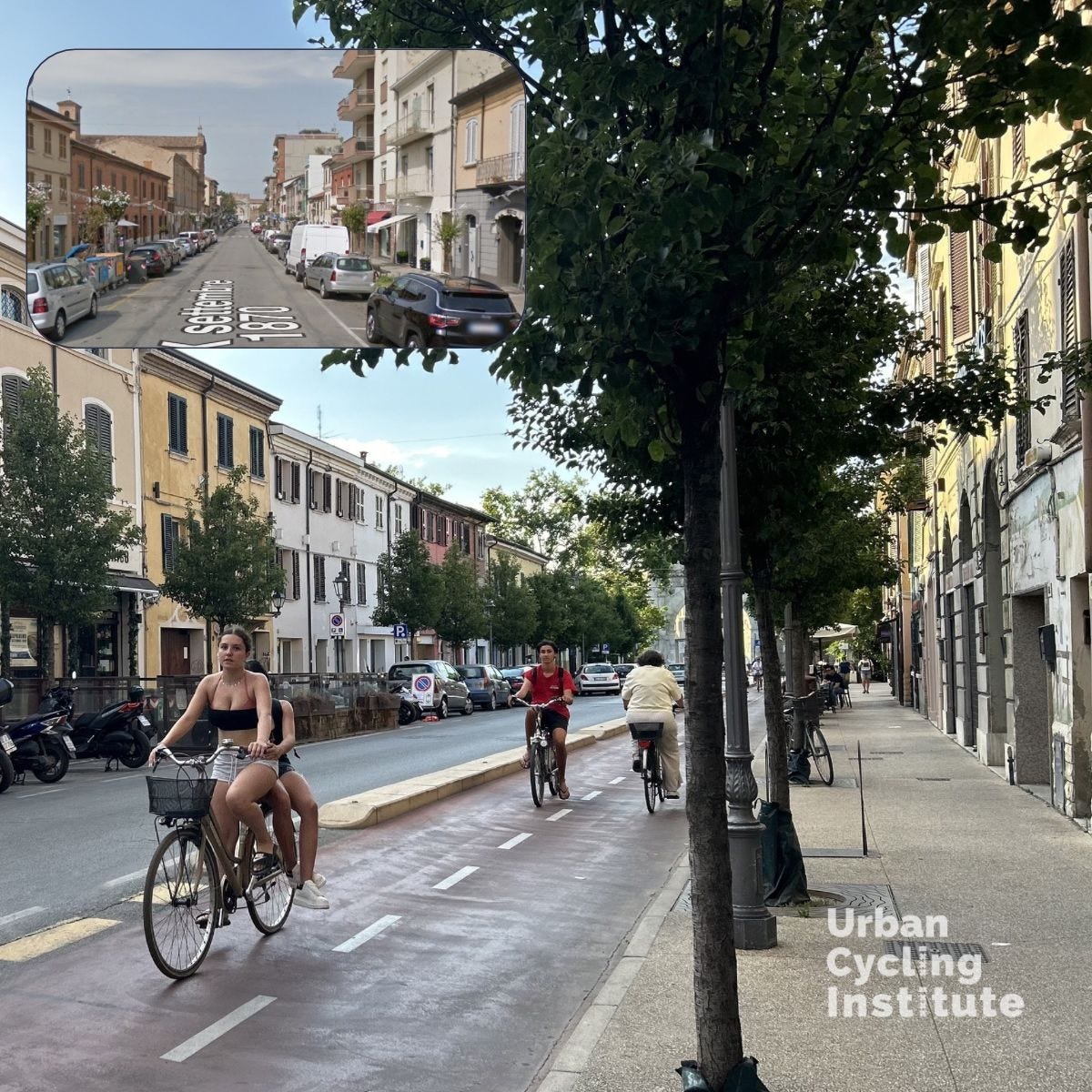
VELO-CITY 2026. The world’s annual cycling conference was in Rimini, Italy, this year, and I’ve been there talking about Pluralistic Ignorance, and hearing from leaders from around the world, from activists to politicians. It’s a city that has transformed to make it more friendly for people cycling and walking and it gets my thumbs up. These before and after pictures on LinkedIn from Urban Cycling Institute CEO Meredith Gaser really show the change.
BUILDING CYCLING CONFIDENCE IN ADULTHOOD. A ‘lost generation’ of adults lacks the confidence and skills to cycle, according to the Bikebility Trust. In a poll of 2,000 people, it found 25% were more confident after cycle training, and 18% were more able to ride in traffic. However, access to training in adulthood remains ‘extremely limited’ and, the Trust argues, needs expanding. Cycle routes - physical infrastructure - are key, but so is giving people the ability to use them. The Bikeability Trust celebrated its 18th birthday last week, and its CEO Emily Cherry was given an MBE in the King’s Birthday Honours, for services to active travel for children. Congratulations!
HOW WAS BIKE WEEK FOR YOU? Penny Farthing-based record-breakers at the London nocturne. Stories celebrating cycling’s transformational power in people’s lives. Bike Week is a chance to recognise how cycling can bring people together, improve our health, help us enjoy life and explore our surroundings. As Chris Boardman reminds us this week in Active Travel England’s delivery plan, Worth Every Step, it also helps save money, if people can cycle instead of owning a second (or third) car.
OTHER HEADLINES
GREEN CYCLE ROUTES. Our latest Streets Ahead episode features Laura Laker in Cardiff, talking to a councillor, a council officer, a (now) Welsh Assembly Member and a campaigner about how cycle routes are being integrated with things like rain gardens. Wales is a world-leader on so many pieces of legislation, from its Active Travel Act to the Wellbeing of Future Generations Act and rules requiring sustainable drainage, or SuDS, to be installed wherever there’s a new development impacting rainfall over 100m2. The outcome is an increasingly green city, in which nature is beginning to return.
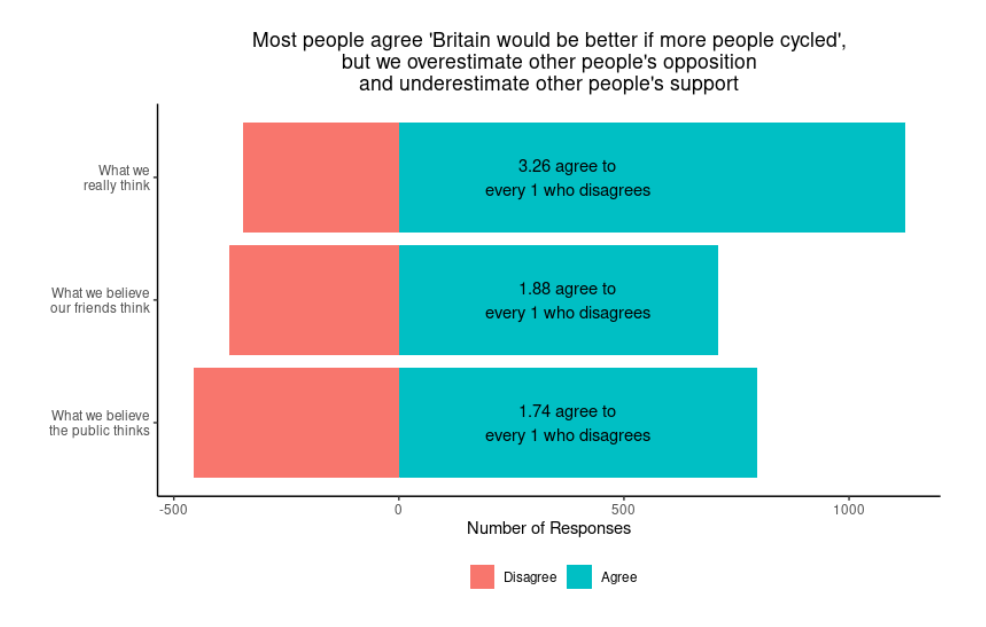
INTERESTING GRAPH OF THE WEEK: A graph I showed at Velo City:
Most people agree Britain would be better if more people cycled, but we overestimate other people’s opposition and underestimate their support. This phenomenon, known as pluralistic ignorance (see word of the week), means politicians too often fail to deliver cycle routes, imagining - incorrectly - people don’t want them.
ACTIVE TRAVEL WORD OF THE WEEK:
PLURALISTIC IGNORANCE. The phenomenon where people mistakenly believe that most people hold a different opinion than their own. In active travel, as with some clean energy policies, this means politicians also overestimate opposition to such schemes, and underestimate support, even if they support measures themselves.
Until next time,
Adam Tranter
CEO, Fusion & Founder, #BikeIsBest
This newsletter is brought to you by Fusion, the agency for movers, specialising in communications and public affairs for active travel and mobility.


Unfortunately, the majority of the pubic are motorists. When putting in more cycling infrastructure is framed as a war on motorists, this results in a tide of opposition. Most politicians and councillors like to play it safe and not upset their constituents.
So, although the idea of active travel appeals to many people, they are often out shouted by the naysayers who don't want money to be "wasted" (as they see it) on anything that can be construed as "detrimental" to the motoring majority. Very sad!
There is at least a glimmer of hope in that worthy organisations and outlets such as BikeisBest, are steadily chipping away at the old block. It may be made of granite, but chip away indeed🙂