


This week has underlined for me the stark contrast between short-term piecemeal delivery of urban projects and the wisdom of a long-term approach. Delivering projects one by one, as funding comes along, rather than as part of a long-term strategic plan creates a politically and at times personally painful, labour-intensive, cash-inefficient workload for resource-stretched councils. The solution: invest in streetspace, long-term.
BIG STORIES FOR CYCLING ADVOCACY
AUSTERITY AND SHORT-TERMISM HARM LTN ROLLOUT. That’s the conclusion of one study that interviewed local council officers and councillors both in and outside of London, around the roll out of Low Traffic Neighbourhoods, 2022-2024. Cuts to expert council staff members and the reliance on consultants, allied with a stop-start funding landscape, left local authorities on the back foot, it found. Individually-funded projects had to be bid upon, explained to the public, planned and delivered quickly, only for the momentum to stop, the consultants to move on and the council forced to start from scratch again. This ‘projectification’ of urban planning left some local authorities poorly prepared to avoid or mitigate any backlash. The solution: long-term funding and proper resourcing of local authorities.
LOCAL AUTHORITY STANDS UP TO MISINFORMATION. One employee of Wokingham Borough Council took to social media to show how public engagement can work, given the resources. James from Wokingham responded to Facebook users’ misinformation around new 20mph limits and a new bike lane in Woodley and Earley. From correcting the misunderstanding that motorists alone pay for roads and bike lanes, to explaining why crumbling road surfaces weren’t being repaired instead (the cycleway funding is ringfenced), to addressing concerns the lane would narrow the road (he said it’s being built on a former verge), James was right there to calmly provide some context.
SECRETS TO PARIS’ SUCCESS. Cycling in Paris surged by 240% between 2018 and 2023. Drawing from multiple sources, researchers analysed recent policies and street improvements and found there was more at play than the famous rapid-expansion of its bike lane network. As important were measures discouraging car use, like low emissions zones, traffic restrictions and fuel price changes. Calmer streets felt safer to cycle and walk in, while ‘liveability’ measures like new trees, pedestrian zones and public plazas had a measurable impact on people’s desire to be outside and active. All part of a long-term plan, of course.
BBC TURNS ON PAVEMENT PARKING. After the recent announcement of the - albeit unsatisfactory - new powers for local authorities to tackle pavement parking, the BBC has several stories on the issue. In Grimsby, a blind woman who uses a wheelchair, was reduced to tears because she cannot get out of the house. In Manchester residents are having to step out into the road to avoid vehicles parked on the pavements, including those with visual impairments. See also: testimony from a blind woman and her guide dog in Leeds and a new Public Space Protection Order in Caterham, Surrey, responding to long-standing frustrations over nuisance pavement parking. The BBC’s In Touch also ran a piece on the issue.
SMALL EXERCISE BOOST = BIG BENEFITS. ‘Just five minutes’ extra exercise, and half an hour less sitting time each day could help millions of people live longer,’ reports the Guardian. A study of 135,000 people from the UK, US, Norway and Sweden found just five minutes’ more moderate exercise, like brisk walking (or cycling) a day, was associated with a 10% reduction in deaths. The benefits, as we know, are greatest for those who are least physically active to start with. If you add just five minutes’ more sleep, and half a serving of extra veg a day, you could live an extra year, researchers found.
OTHER HEADLINES
THE BEST THING ABOUT GIVING UP A CAR: MONEY. This relates to a Reddit post, now deleted, that became a Momentum Mag article. The simple question about the benefits of a car-free or car-lite life, inspired a lot of answers, top of which was the immediate financial savings. Car ownership costs Americans $12,000 a year, and rising fast, according to one source. Savings to the tune of hundreds, or thousands of dollars a month, therefore track - meaning being able to afford things like rent. Then there’s the ‘mental freedom’ that comes with no longer worrying about unexpected costs like breakdowns. Then came the very real fitness and health benefits.
INTERESTING GRAPH OF THE WEEK:
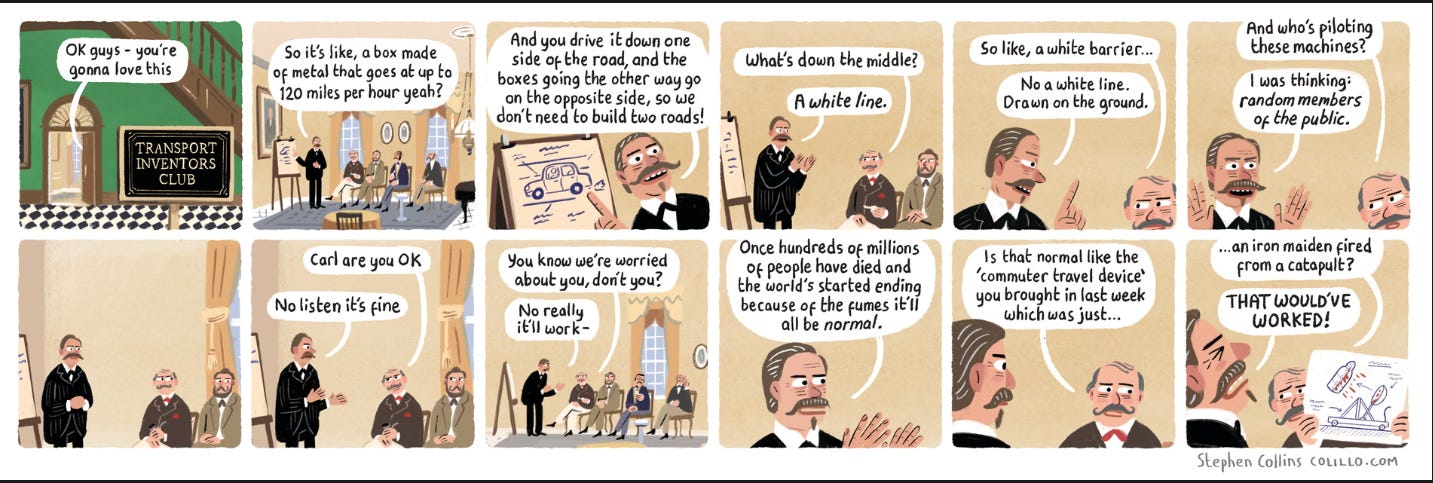
STEPHEN COLLINS NAILS IT. The cartoonist Stephen Collins has produced a couple of doozies in recent months around the dangers we blithely accept when it comes to cars. This one sums it up perfectly (click on the link for full effect):
ACTIVE TRAVEL WORD OF THE WEEK:
Projectification: Where things like Low Traffic Neighbourhoods are bid for, planned and delivered in small batches, rather than as part of ongoing long-term plans. As well as being incredibly inefficient, gained expertise leaves with the consultants at the end of each project, rather than being part of an ongoing workflow within the local authority. The result: poor communication to the public, and a limited ability to deal with the resulting backlash.
Until next time,
Adam Tranter
CEO, Fusion & Founder, #BikeIsBest
This newsletter is brought to you by Fusion, the agency for movers, specialising in communications and public affairs for active travel and mobility.

Really smart framing on "projectification" - this concept nails whats wrong with so much urban planning today. The Paris example shows what happens when cities commit to a long-term vision instead of chasing individual funding cycles. It's wild how we accept inefficiency and burnout as normal when the fix is just commiting to sustained investment. Great roundup of the recent advocacy wins too!