This week, we’re taking a look at some of the issues around the driverless taxis being trialled on city streets around the world. From parking in bike lanes to ploughing into crime scenes, these malfunctions need tackling - not excuses. Meanwhile, we’ve a podcast episode on children’s access to streets. Spoiler: cars ruined childhood freedoms and, unfortunately, driverless vehicles won’t make it any better.
BIG STORIES FOR CYCLING ADVOCACY
LOWERING THE BAR? Are driverless vehicles being allowed to ignore safe driving standards, including stopping in cycle lanes? In the USA at least, there is a growing body of evidence suggesting this might be the case. Advocates in San Francisco say they are routinely pulling into bike lanes, which Waymo denies. One cyclist is suing Waymo for driving into a bike lane to drop off a passenger, who then doored them. While this is new technology, fixing errors that risk safety should surely be a priority.
NYC PAUSES WAYMO TRIAL. In the meantime, New York City has not renewed tech company Waymo’s license to trial the vehicles, which expired at the beginning of April. The city’s democratic socialist mayor, Zohran Mamdani, underlined that his city government was “committed to delivering for the workers that keep the city running…” including its taxi drivers. This is perhaps a jab at tech companies Uber and Lyft, which have in the past used loopholes to avoid paying its drivers the minimum wage.
WAYMO DRIVER PLOUGHS INTO CRIME SCENE. In another malfunction, a Waymo taxi was filmed driving straight through police tape at a crime scene in north London, late last month. The vehicle was apparently in manual mode at the time, i.e. a driver should have been in full control. The driver reversed out of the cordon after ‘a brief interaction’ with police officers, according to Waymo, who claimed had it been in autonomous mode it wouldn’t have happened. Which you can choose to believe or not. The robotaxis are set to be rolled out in London in September.
CHILDREN’S ACCESS TO STREETS. Our latest Streets Ahead episode features childhood advocates Tim Gill and Alice Ferguson, and their battle cry for children’s access to streets. After decades of warm words on improving childhood mobility close to home, too little has been done, they say. Their new report underlines that the dominance of motor traffic, and the risks it poses has eroded the ability for children to access their neighbourhoods. The stark implications for child health and wellbeing are well-known. What will end this century-long pandemic, as Gill puts it - and why haven’t we acted on the clear evidence of harm?
CAN THE US EMBRACE PUBLIC TRANSPORT? Cycling and public transport should go together like toast and butter. It’s no coincidence the world’s most cyclable places also prioritise public transport: see Paris, London, Helsinki, Ghent. In the US, a recent report found that it would take $4.6tn to bring the nation’s bus and rail services up to world-class levels. Aside from a few exceptions, new developments tend not to include non-car transport options. With global urban populations booming, and recent oil price shocks underlining the fragility of car-dependent urban planning, resilient multi-modal transport systems are essential.
OTHER HEADLINES
WHAT OF BIRMINGHAM’S ROAD SAFETY CONSENSUS? Why did Birmingham’s politicians recently disagree on the need for slower traffic speeds? 20mph has been a local Labour policy goal since 2012. The city administration declared a road safety emergency last year, after 80% of casualties were recorded on roads with a 30mph limit. As recently as 2024, the council asked the Department of Transport for permission to apply cost-saving signage for a default 20mph on residential streets. As I mentioned last week, that all changed at a recent hustings, when politicians failed to back 20mph. The evidence is clear: 20mph saves lives, cuts insurance premiums, helps boost walking and cycling, and people support it. Somehow that’s all been forgotten with local elections looming.
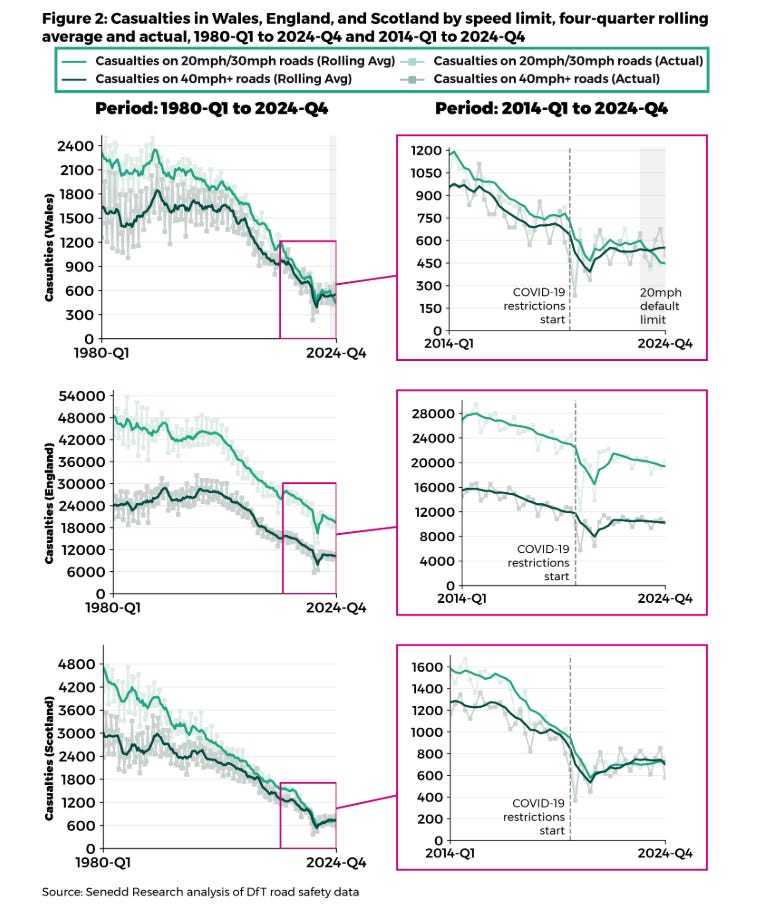
INTERESTING GRAPH OF THE WEEK: Again, for those at the back: how 20mph reduced road casualties in Wales, vs England and Scotland. Source: https://research.senedd.wales/research-articles/what-impact-has-20mph-had-on-road-safety-in-wales/
ACTIVE TRAVEL WORD OF THE WEEK:
Balancing the needs of all users? Mark Philpotts, aka Ranty Highwayman, says this phrase sends shivers down his spine, as it usually means motor vehicle movements are prioritised. I agree. What we need instead, he argues, are minimum levels of service for those at the top of the transport hierarchy, i.e., walking and cycling - with parking for private vehicles considered last.
Until next time,
Adam Tranter
CEO, Fusion & Founder, #BikeIsBest
This newsletter is brought to you by Fusion, the agency for movers, specialising in communications and public affairs for active travel and mobility.