


This week, we’re dodging delivery robots, a Gish galloping presenter (see ‘word of the week’), oil shocks and more. In London, road deaths are down but serious injuries are, unfortunately, up. And while we know many of the solutions to this urgent issue, running the gauntlet of public opinion, and talk show hosts, is never straightforward. Given what we know about road danger, imposing speed limits for cycling doesn’t seem like much of a solution.
BIG STORIES FOR CYCLING ADVOCACY
DELIVERY ROBOTS - MORE PAVEMENT MISERY? Delivery robots are yet another thing vying for our already narrow and contested pavements. According to 2020 research 70% of UK pavements are less than 3m wide, and 34% - just over a third, are sub-2m. Given these bots are 55-70cm wide, it will be challenging for wheelchair users, blind or partially sighted people, or someone with a pushchair to pass or, in some cases, access a drop kerb. This means being forced into the road, or being unable to proceed at all. Delivery bots exist in a legislative grey area - under the 1835 Highways Act, ‘carriages’ can’t operate on pavements - and the government hasn’t yet clarified the bots’ status. It seems delivery companies have found a new way to inflict more misery on us, and we are doing very little about it.
TALK SHOW EXTREMISM. Last week, journalist Laura Laker appeared on Julia Hartley-Brewer’s right-wing show, Talk. Ostensibly there to discuss Cambridge’s cycling street, it was pretty clear from the start JHB was hostile to the concept, saying cyclists and pedestrians already had too much priority on the streets. What happened from there was a classic ‘Gish Gallop’ (see word of the week) from JHB, in which she fired half-truths and hyperbole, presumably to confuse her guest. When Laker gamely refused to be interrupted, JHB turned off her microphone. Hardly edifying television.
THAT CYCLE STREET. It seems sensible to protect the most vulnerable road users - not least when there’s a lot of them - so it’s welcome that Cambridge has just opened England’s first Cycle Street. Common in the Netherlands, and indeed in cities like Berlin, the idea of a cycle street is to make it a bit more comfortable to cycle and walk by asking drivers not to try and overtake them, while removing parking and narrowing the carriageway to make it safer. On Adams Road in Cambridge, there are already 3000 cycle trips during peak times (not per day, as reported elsewhere), in a city where 45% of people cycle at least once a week. That hasn’t stopped some parts of the media (see above) losing their composure over the changes.
LONDON ROAD DEATHS FALL TO NEAR-RECORD LOW. London just recorded the second lowest death toll on its roads, which were down 13% in 2025 vs 2024, according to provisional figures. Transport for London says 96 people were killed last year, compared with 110 in 2024. It’s still an awful toll for a transport system. Serious injuries, unfortunately, have risen in that time, from 3,597 to 3,900. There are clear trends: 81% of those killed or seriously injured were walking, cycling or on a motorcycle, while speeding and dangerous driving were key factors in collisions. London’s Vision Zero Action Plan aims to address these known trends via things like wider 20mph speed limits, junction improvements, camera enforcement of driving offences and expansion of the city’s cycle network.
SPEED LIMITS ON BIKE LANES? Amsterdam, like the UK, has a growing problem of illegal e-bikes on streets. Its solution is, contrary to recommendations by cycling organisations, to trial a suggested speed limit on its cycle lanes. This speed limit won’t be enforced, so it begs the question, what’s the point? Suggestions we follow suit in the UK are made without apparent irony: while we need to crack down on illegal ebikes here, too, pointing the finger at cycling more broadly would be a mistake, given the benefits. We’d surely be better off tackling speeding drivers, who are contributing to significant proportions of the deaths and serious injuries on our roads each year.
OTHER HEADLINES
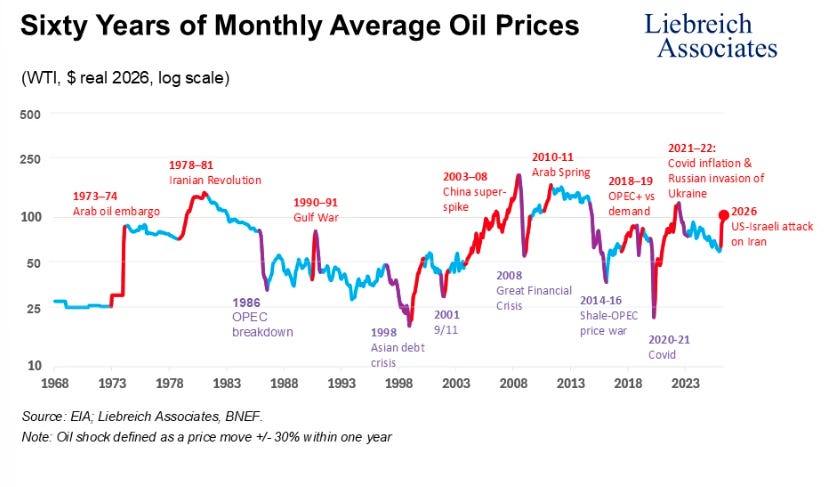
CYCLING = OIL SHOCK RESILIENCE. The Strait of Hormuz shows no sign of clearing, and in April the European Cyclists’ Federation set out ten measures to boost cycling and improve nations’ resilience, beyond doubling down on fossil fuel subsidies. Immediate solutions include temporary cycle lanes, lower urban speed limits, targeted financial incentives for bicycles, e-cycles and repairs, car-free days, and cycle tourism promotion. Longer-term ‘structural’ reforms include familiar things like reallocating 10% of transport budgets to active travel, developing coherent cycle networks, bike-to-school programmes and bike leasing schemes.
INTERESTING GRAPH OF THE WEEK: This may be the second oil shock in four years, but as this Bloomberg piece by clean energy businessman, Michael Liebreich, points out, it’s part of a much longer-term trend. Reducing reliance on fossil fuels would seem a good long-term solution. Source: https://about.bnef.com/insights/clean-energy/liebreich-the-great-clean-energy-acceleration-2-0/
ACTIVE TRAVEL WORD OF THE WEEK:
Gish Gallop. A tactic used to overwhelm a debating opponent by presenting a barrage of arguments, regardless of their accuracy, at a speed that makes it impossible for that opponent to address them in time. It’s sometimes used to undermine the audience’s opinion of the target opponent - but it can backfire.
Until next time,
Adam Tranter
CEO, Fusion & Founder, #BikeIsBest
This newsletter is brought to you by Fusion, the agency for movers, specialising in communications and public affairs for active travel and mobility.
