


Well, friends, we made it this far, to our two hundredth edition. Meet us on the hill of hysteria for a celebration. Understand why people resist change, and why safety can mean different things for different people.
BIG STORIES FOR CYCLING ADVOCACY
DAILY EXPRESS’ WOMEN’S SAFETY CRUSADE. On Monday, the Daily Express’ front page called for better street lighting, for women’s safety. This is in response to money-saving efforts by councils that include switching off street lights at night. In the newspaper’s feature Cycling UK’s Sarah Mitchell has written about the calculations female cyclists make when choosing a route after dark. Too often it’s between a busy, potentially intimidating road and an unlit, potentially unsafe traffic-free path. Cycling UK’s campaign, My ride. Our right seeks to highlight and solve this problem. At the moment, men make twice as many cycling trips as women and ‘social safety’, as it’s termed, is one of the reasons why.
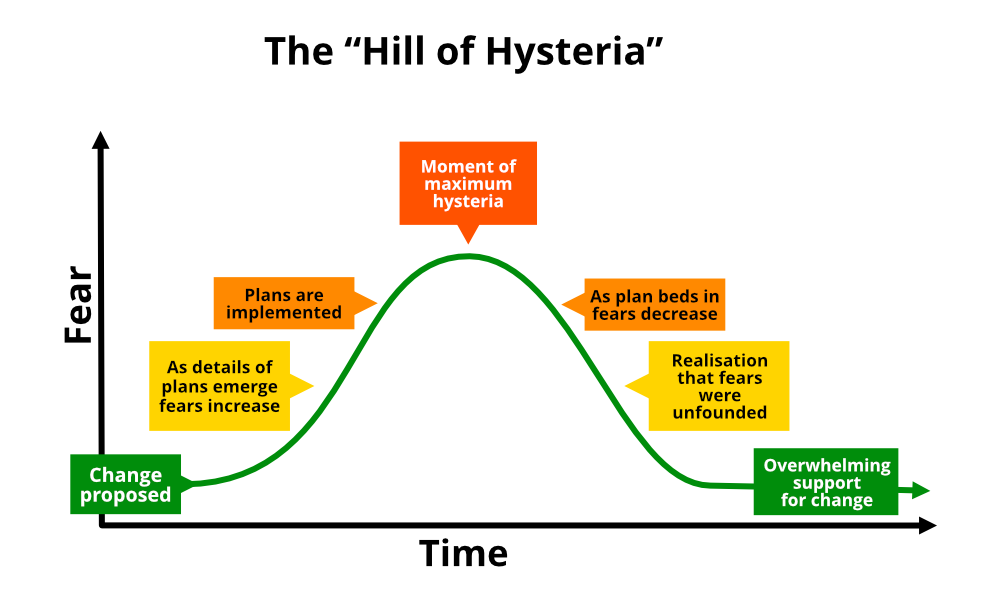
WHY DO PEOPLE RESIST CHANGE? Global Cycling Network (GCN) has taken a look at streetspace changes, and why they can be so controversial. In this 24 minute video, GCN’s Si Richardson looks at Low Traffic Neighbourhoods in Bristol, why they are being introduced and what the impacts are. In vox pops and interviews with politicians and experts, Si examines the opinions of some of those for and against the schemes. He also encounters the ‘hill of hysteria’, a behavioural phenomenon that describes the peak of outrage over streetspace changes, before the usual widespread acceptance once schemes bed in. He also encounters status quo bias.
WELCOME TO THE HILL OF HYSTERIA. One of GCN’s expert interviewees, Alexander Premm, has mapped the public reaction around motor traffic reduction policies. ‘The rise’ features familiar claims of harm around such policies from “small but vocal group of citizens defending the multi-generational narrative of car-centric planning” with protests and legal challenges. ‘The peak’, Premm says, requires strong political leadership not to back down under at times intense pressure. This allows ‘the descent’ from the hill, when people realise “it’s much nicer this way”. Ultimately, people don’t like change and while genuine concerns should be properly heard and responded to, much of the concern will turn out to be unfounded.
CYCLING INTERVENTIONS: WHAT WORKS? Cycle share schemes, e-cycle loans, secure parking and workplace interventions all help people cycle more. What’s more, large-scale, ambitious infrastructure improvements have far greater impact than smaller schemes. Those are just some of the findings of a research review published by Active Travel England. It looked at 28 studies across programmes to increase cycling. Among the barriers to cycling it identified were safety concerns, particularly for women and disabled people, a lack of infrastructure, cost and a lack of access to cycles.
RIGHT ARM IN, RIGHT ARM OUT. A US study has concluded that arm signals are the clearest form of communication cyclists can use on the roads, with drivers. In a simulation, ‘drivers’ were asked to interpret cyclist intentions from their actions, including road positioning and head movement. Arm signals were, by far, the clearest. By law, cyclists in the US must signal before turning or, curiously, before slowing down - which is challenging should you also need your hands on your brake levers. Drivers’ ability to interpret cyclist signals decreased during a simulated phone conversation, underlining the risks of distracted driving, which feels like the bigger finding…
OTHER HEADLINES
HOW CITIES CAN TACKLE SPEEDING DRIVERS. Speeding drivers are responsible for about a third of all crash deaths in the US, and small increases in speed substantially impact survivability of a crash. This piece, by CityLab’s David Zipper, outlines which interventions work - and which don’t, following a deep-dive into cities’ efforts to curb speeders. Zipper found physical interventions, like speed cameras, narrowing streets and removing ‘green wave’ traffic signalling that encourages speeding, ‘are effective, often to a striking degree’. Which then begs the question, why aren’t there more of these life-saving interventions?
INTERESTING GRAPH OF THE WEEK: The hill of hysteria, in graphic form. Source: https://wbrassociation.org.uk/why-changing-our-environment-is-so-hard/
ACTIVE TRAVEL WORD OF THE WEEK: Status quo bias: a cognitive bias which favours the current situation, even if a new situation is potentially better. This phenomenon is often seen in proposed streetspace changes.
Until next time,
Adam Tranter
CEO, Fusion & Founder, #BikeIsBest
This newsletter is brought to you by Fusion, the agency for movers, specialising in communications and public affairs for active travel and mobility.
Congratulations! I managed to get ‘Status Quo Bias’ on to the letters page of my local paper today https://app.thecourier.co.uk/full_page_image/19-02-2026-page-29_ac781053/content.html
Congratulations Adam and thankyou for your very informative newsletters which I have been reading for many months now. Interesting reading about cognitive bias and the Hill of Hysteria. I've seen so many European countries, indeed have even lived in both The Netherlands and Switzerland for a time. Traffic-free and low traffic routes and neighbourhoods are everywhere. The resulting environments are so much more pleasant than we typically have in the UK. If those unfortunate to suffer from cognitive bias (and there are many) could just pop across The Channel and see this for themselves, then I'm certain that they would all be cured of their ailments😁
Thankyou once again.