


London and Paris have, like many European cities, just suffered through a record-breaking heatwave, leading to premature deaths and growing concern about our adaptation to climate change. Cities might well look with renewed urgency at their climate resilience plans. Meanwhile, I’m raging against the robots, Active Travel England is looking for a new CEO, and do fewer cars mean less crime?
BIG STORIES FOR CYCLING ADVOCACY
SCHOOL STREETS = COOL STREETS. Research from Paris earlier this year found school streets, which often become rues jardin, aka garden streets are, on average, 5C cooler than neighbouring streets. In many cases, trees and shrubs shade the space and reduce the hard surfaces that can warm up in direct sunlight, while cooling (i.e. lighter shaded) pavement better reflects the sun’s heat. Thermal imagery and in-person visits assessed all of Paris’ 272 school streets and found one school street was 12C cooler than its neighbour. It’s something other cities might think about.
WHY I’M RAGING AGAINST MACHINES. Tech companies have a track record of promising shiny solutions to urban problems that don’t work (see my last Substack post). We saw this with Uber, whose empty, circulating taxis drive up the congestion the company promised to help reduce - and with Elon Musk’s Superloop, an expensive way to build an extra traffic lane underground, which is still underperforming. Now, delivery robots and autonomous taxis threaten to do the same thing on our pavements and roads. This week, pedestrian charity Living Streets wrote a letter calling for Transport Secretary, Heidi Alexander, to proceed with caution on any plans to legalise these delivery robots, amid signs they are about to get the green light - our pavements are congested enough as it is.
CYCLING > CARS IN CITY OF LONDON. In the Square Mile, the number of cycles has overtaken the number of cars for the first time*, growing by 57% since 2022. There are now four times as many dockless e-bikes, and 60% more personal cycles in that time - and cycles are now 56% of all traffic in rush hour. Meanwhile, motor vehicle use has steadily declined, including buses and taxis. City of London data (see graph of the week) clearly shows inflection points when motor vehicle use dropped notably, including the global recession in 2008, the congestion charge zone and cycle superhighways opening, and the Covid pandemic. Paris achieved this feat back in 2024, as a recent Momentum article reminds us. *presumably also during the 1950s cycling boom.
CUTTING CARS CUTS CRIME. We’ve all experienced the hostility of congested streets: the noise, the speed, the air pollution - and the sense we’d rather be elsewhere. Well, busier streets become less safe in other ways, too. A new study from the University of Leeds found perceptions of crime - and crime itself - rise with heavy traffic in a neighbourhood, and that reducing traffic can also reduce vandalism, burglary and violence. Using ‘robust, longitudinal data’, researchers say they are confident about the causal relationship between the two - with potential explanations being that neighbours on busy streets talk to one another less, and therefore trust each other less, as well as feeling less ownership of shared spaces.
POOR-VALUE ROADS SCRAPPED? A series of high-cost road projects that are known to be poor value for money could be scrapped to help plug a gap in defence spending. On the £700m-value list are two legacy schemes from the previous government, the A46 Newark bypass and A38 Derby junctions, which Labour was expected to cancel last year. The government will consult on scrapping them, and possibly more. Government departments will also be asked to contribute 1p for every £1 of their capital budgets.
OTHER HEADLINES
HAMMERSMITH BRIDGE TO REMAIN CAR-FREE. That’s the conclusion of a council report estimating the cost of repairs to the elderly structure at an eye-watering £300m. The report will be considered by the council next week but, it says, “there is no financial option available that would allow its full restoration.” Instead, ‘phased repair’ will prioritise the most urgent structural issues, while keeping the bridge open to cycling, walking and wheeling, reports the Evening Standard. The Times highlights that, according to Telraam counter data, around 12,000 people are walking and cycling on the bridge, so it’s not closed, is it?
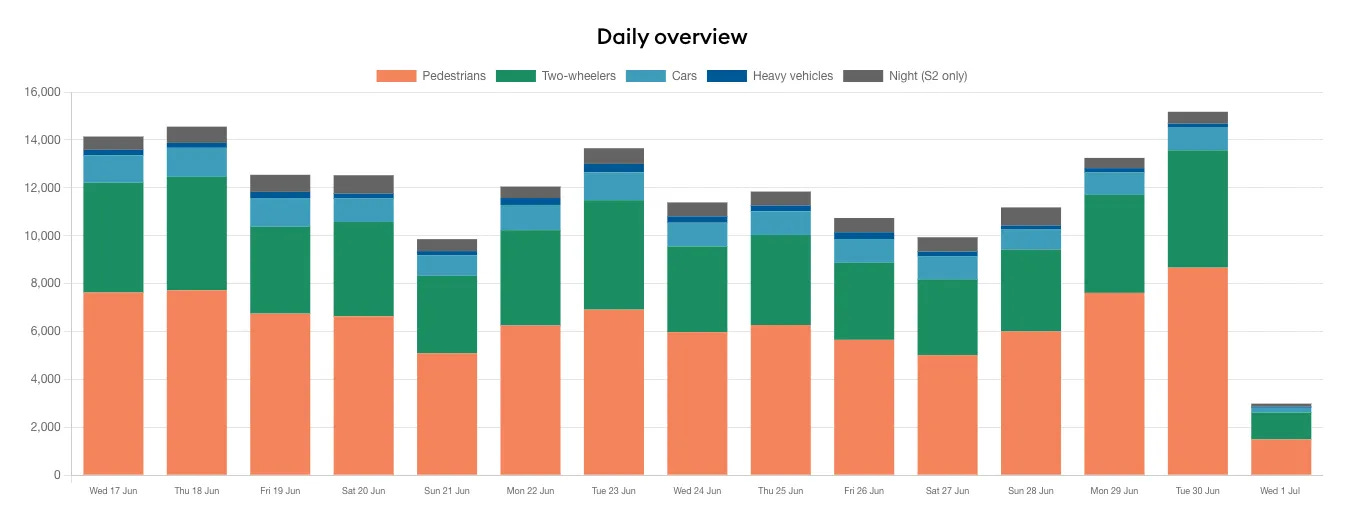
Source: Telraam
ACTIVE TRAVEL ENGLAND NEEDS YOU! Could you be the next CEO of Active Travel England? After Danny Williams’ departure, following four successful years of service, the body delivering walking, wheeling and cycling programmes in England is looking for a new leader. With active travel at an exciting inflection point, as ATE starts to deliver on the third Cycling and Walking Investment Strategy (CWIS3) and billions of pounds of active travel programmes, it’s set to be a demanding, but rewarding role.
INTERESTING GRAPH OF THE WEEK:
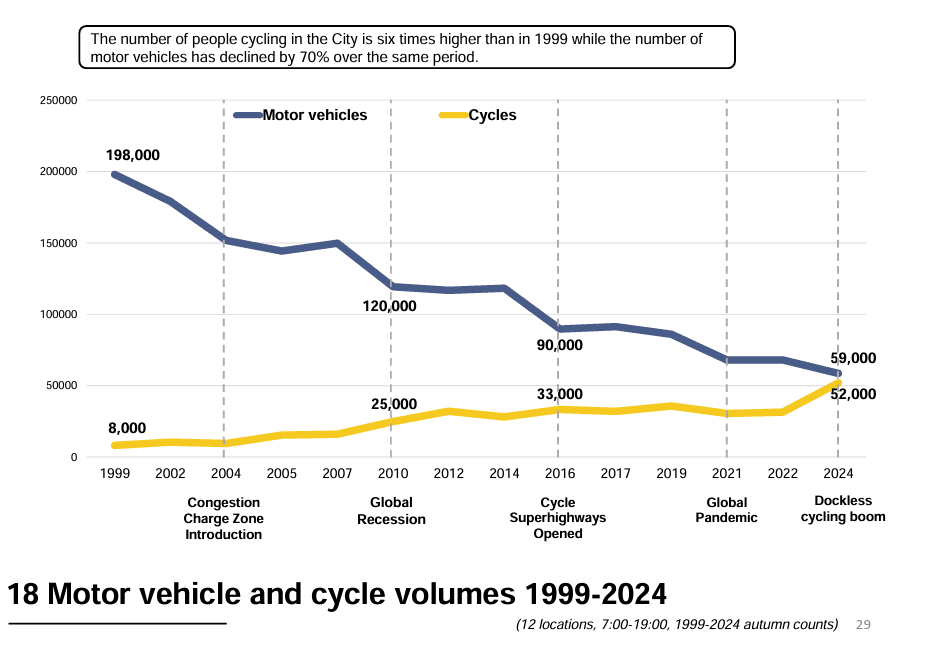
Cycles up, cars down: Cycling now outnumbers driving in the City of London. Source: https://www.cityoflondon.gov.uk/assets/Services-Environment/City-Streets-2025-Summary-Report.pdf
ACTIVE TRAVEL WORD OF THE WEEK:
Collective efficacy. A group’s shared belief in its ability to organise and execute something to achieve a common goal. In neighbourhoods this might involve coming together to look out for one another and the shared streetspace, and to trust one another to do so. From this week’s study on traffic and crime, by Leeds Uni.
Until next time,
Adam Tranter
CEO, Fusion & Founder, #BikeIsBest
This newsletter is brought to you by Fusion, the agency for movers, specialising in communications and public affairs for active travel and mobility.

So look forward to this each week (I think weekly). Such a clear, data driven, round up of all things cycling.