


This week we’re feeling springlike over at #BikeIsBest headquarters. In the spirit of spring cleaning, there are some new solutions to some old problems - some of which are already being deployed. Change can be hard, but as the trees fill with blossoms, there’s a whiff of possibility in the air: it’s out with the smog, in with the fresh breeze.
BIG STORIES FOR CYCLING ADVOCACY
SAFER STREET DESIGN. Almost nine in ten women have felt unsafe walking at night, according to new research - and seven in ten have altered their walking route after dark, as a result. These are shocking statistics behind which are real people whose access to the streets, and opportunities, is being hampered. This week, to tackle the problem, the government launched council guidance on active travel route solutions, like improved lighting and visibility, CCTV and ‘natural surveillance’ (see word of the week). They’ll be holding workshops across the UK to help those working in transport to help tackle the problem.
…BUT NOT FOR CYCLING. As the London Cycling Campaign points out, there’s no mention of cycling. While traffic-free routes are scary on foot or pedalling, the solutions differ: a walker may choose a pavement alongside a busy road at night, whereas a cyclist will then potentially face traffic danger. As LCC points out, crime rates in Low Traffic Neighbourhoods are lower, and there’s potentially better ‘natural surveillance’ because people are on foot or cycling themselves, not rushing past in vehicles. The LCC’s Women’s Network has researched and reported on some of the issues, here. Hopefully the forthcoming workshops will tackle this issue.
INTEGRATE! Like other National Parks, the New Forest is hitting the limits of a transport system designed around the car. Visitor traffic, with a growing population, causes congestion, air pollution and road danger. A summit to explore the problems, and their solutions, was clear: integrate transport so people can travel car-free. People want to walk, wheel and cycle, but they need safe routes, including to bus and rail stations. Ebikes can boost the numbers of cycleable trips, but they need secure parking. Roads can be made safe by ‘filtering’ through traffic, speed limits reduced and cycleways built. Even in a National Park most journeys are short, and the car isn’t the best tool for the job - but it takes joined-up thinking to change behaviours.
NEW LIME BIKES DROP. Lime Bikes are incredibly well used, carrying countless riders in cities around the world daily. Popular as they are, however, the bikes can be heavy and cumbersome, and have given rise to what healthcare professionals have termed ‘Lime Bike leg’ - a particular kind of lower limb break. A new design has now seen that chunky down tube lowered, and fitted with smaller wheels, giving the bike a lower centre of gravity. Also lower is the basket, and there’s even a ‘modular rear rack’, which can be adapted for things like child seats. Walk Ride GM’s Harry Gray approves, for one.
CHANGING LANES. A personal tragedy sparked a community pushback - and an upcoming film details their struggle. When a teacher was killed in a hit-and-run collision in Brooklyn, a grassroots movement pushed to reduce a four-lane highway to two lanes, adding a cycle lane. Featuring music legend, David Byrne, and former transportation commissioner of New York City, Janette Sadik-Khan, the movie is aired in Los Angeles next month, and via Bicycle Film Festivals - hopefully in the UK. It takes a micro look at a widespread problem: how communities can help tackle road safety, despite loud opposition from vested interests.
OTHER HEADLINES
MONEY TO QUIT DRIVING. Young drivers in Malta are being offered an eye-watering €25,000 to quit driving, in a bid to cut car traffic on the Mediterranean island. Those under 30 who have held a driving license, and lived in Malta, for a number of years, will receive €5,000 installments for handing in their license, and for each year they abstain from driving. Malta’s roads are the second most congested in the world, with car ownership growing to ‘epidemic levels’: 20% of households have more than three cars. With little apparent political appetite to limit the harm by taxing drivers, this €25m giveaway seems to be the next best thing.
INTERESTING GRAPH OF THE WEEK:
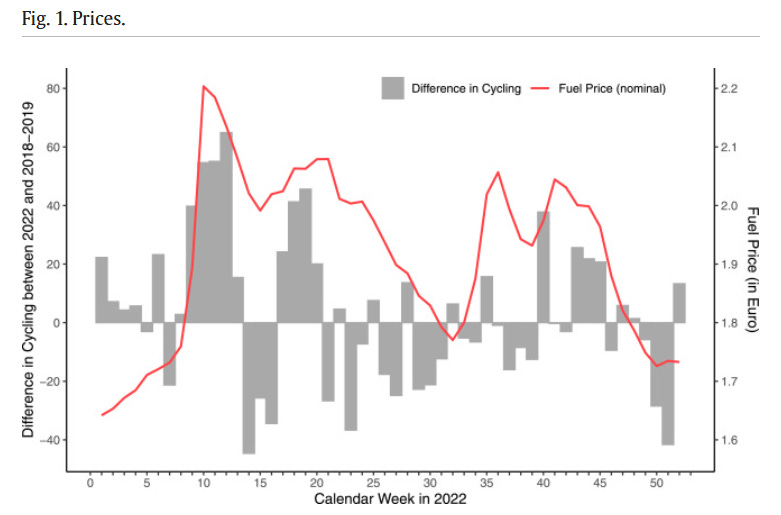
The US and Israel’s war in the Middle East is devastating for people living in the region. It’s also hiking fuel prices globally. This in turn impacts travel choices, as seen on this graph, below. As Bloomberg journalist David Zipper put it, Trump may dislike green transport, but his actions are ‘a giant tailwind’ for cycling. Ultimately, when driving becomes more expensive, we do less of it. Source: https://www.sciencedirect.com/science/article/pii/S0965856424001940
ACTIVE TRAVEL WORD OF THE WEEK:
Natural surveillance. Designing spaces, including cycling and walking routes, so they are naturally overlooked by windows and other passersby, with good lighting at night. The idea is to increase the risk of wrongdoers being detected, creating a sense of security for users, particularly for women.
Until next time,
Adam Tranter
CEO, Fusion & Founder, #BikeIsBest
This newsletter is brought to you by Fusion, the agency for movers, specialising in communications and public affairs for active travel and mobility.
Hi, when featuring Lime Bikes and saying how wonderful they are, especially with the new safety design.......they should have been checked for safety in the first place!!! Secondly, they still haven't solved the issue of them being dumped 'everywhere', on pavements, in places they are banned from entering, flat on the floor in large quantities in windy weather, especially. Also, the effect on small indie cycle hire businesses across London like ours in Greenwich, forced into closure through loss of one sector of our market, and who previously were able to deal with potential cyclists (especially from tourists across the world here in Greenwich), who did not want or need an environmentally UN-friendly e-bike!! (Lithium batteries). It's not ALL rosy as u suggest. After 17 years, we will close this year and sell off our bikes. So sad, now US corporations make the money instead, and everyone says Whoopee. We don't.