A lost decade; a decade of dangerous complacency. That’s what the period since Britain’s last Road Safety Strategy has been called. Evidence is crucial in understanding what’s going wrong on the roads, where, why and who is causing danger - and in tackling the problem. This week, we’re hopefully seeing the beginning of the end of stagnating road casualty levels as a new Strategy is announced. There’s also finally a response to the Government’s pavement parking consultation - just five years late.
BIG STORIES FOR CYCLING ADVOCACY
ROAD SAFETY STRATEGY FINALLY APPEARS. And it heralds consultations on a range of things, from measures to tackle drink driving, to extended test periods for new drivers and mandatory eyesight tests for over-70s. It will also tackle illegal number plates, used by rogue drivers to hamper detection on the roads. A long-awaited Road Safety Investigation Branch ‘will analyse collision patterns and inform prevention strategies’ - data that will be crucial to reducing deaths and serious injuries on the roads. There are bold targets, but not a Vision Zero. Let’s hope these road safety consultations don’t take as long as the pavement parking one did to be acted upon.
END OF PAVEMENT PARKING? (TERMS AND CONDITIONS APPLY) Politics is hard, and after many transport secretaries, several governments and lots of frustrated campaigning, today Minister Lilian Greenwood MP issued a statement on pavement parking, following the long-awaited consultation. After much-rumoured “blocking” of the policy from some parts of Government (who claimed it could be perceived as “anti-motorist”), there’s finally some progress to report.
The statement, possibly because of the topic’s perceived political sensitivity, is suitably vague. There will be new powers, but we’re not quite sure what they are. It’s also not clear whether local areas will choose whether they want to enforce or not, leading some campaigners (such as Living Streets) to claim the policy will result in inconsistency for communities and drivers, which increases risks for everyone using our streets. Living Streets wanted a full nationwide ban, as in Scotland.
OVERSIMPLIFYING STATISTICS. You may have seen the Times claiming one Low Traffic Neighbourhood (LTN) generates 1.5m extra driving miles as people avoid ‘filters’. The Ranty Highwayman, aka Mark Philpotts, questions some of the piece’s ‘simplistic’ calculations. The filters affect short journeys proportionally more than long journeys, he notes, which is the point of an LTN, while traffic patterns are formed by human decisions, which is why prioritising walking and cycling by reducing through traffic works. The Times’ article takes neither of these elements into account. It’s not the first or last time such efforts will be made against curbing traffic dominance. That doesn’t mean genuine concerns should be ignored - more that both sides are honest about the upsides and downsides.
QUANTIFYING TRANSPORT POVERTY. Getting around represents a huge cost for UK households, particularly those in rural areas or on low incomes. Despite its role in decreasing poverty, there are currently no metrics to track the cost and accessibility of transport, as Gideon Salutin of the Social Market Foundation points out. Last year the government committed to changing this by launching a transport poverty tool, as part of its child poverty reduction work. Salutin argues this will make visible to the government ‘the millions who are forced into poverty by car dependency’. Fuel duty cuts, SMF says, have failed to tackle this - and the money is better spent on public transport.
£12.76M WALKING AND CYCLING PROJECT GETS GOING. A new walking and cycling scheme is getting underway this month in Leeds. The ‘transformative’ Leeds City Links project will connect the north and south of the city centre with cycle lanes, wider pavements, and traffic layout changes, reports road.cc. There will be space for outdoor cafes, improved pedestrian crossings and some parking and traffic lanes removed. It’s all part of the city’s Vision Zero 2040 strategy to cut road deaths and serious injuries.
OTHER HEADLINES
CYCLE ROUTE GETS NATURE RESERVE. The much-beloved Strawberry Line in Somerset is getting its own nature reserve. That’s because the volunteers who develop and maintain the route, between Yatton Station and Shepton Mallet, are building one. They’ll be fencing off an area near Wells, building a picnic bench with views across the Somerset Levels, and resurfacing a rocky path to make it wheelchair-accessible. All power to their spades.
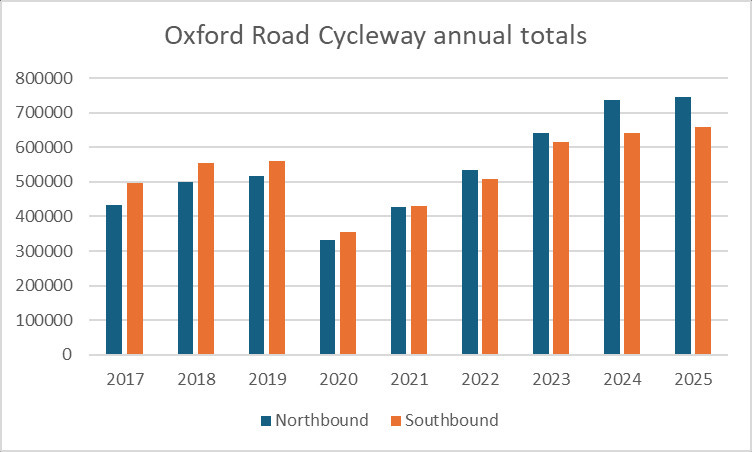
INTERESTING GRAPH OF THE WEEK:
MANCHESTER’S CYCLE NUMBERS BREAK COUNTER. In images from the ‘Oxford Road Cycle Bot’, which collates counter data from the Manchester cycle lane, the annual counter almost maxed out at 750,000 in December, perhaps necessitating a (further) recalibration of the LED-based scale. In 2025 the northbound and southbound lanes together totalled more than 1,400,000 trips. Source is an award-winning local campaigner using cycle count data:
ACTIVE TRAVEL WORD OF THE WEEK:
Operation Tutelage. This award-winning police operation sends letters to registered keepers of vehicles whose motor insurance has lapsed. It ‘compliance-nudged’ 78% of 700,000 recipients to insure their vehicles. Tutelage+ used an expanded dataset to spot MOT and Vehicle Excise Duty lapses, and investigated the growing number of vehicles without registered keepers. The Road Safety Strategy report rightly cites the Tutelage Ops as potential tools for its new, collaborative Roads Policing Innovation Programme.
Until next time,
Adam Tranter
CEO, Fusion & Founder, #BikeIsBest
This newsletter is brought to you by Fusion, the agency for movers, specialising in communications and public affairs for active travel and mobility.