This week, there’s a lot to unpack in the government’s integrated transport strategy. This matters because it starts to consider moving people, rather than vehicles - potentially enabling more car-free journeys, i.e. walking, wheeling and cycling routes to public transport, not just driving trips.
It also empowers local leaders to deliver - see the Peak District’s ‘Mini Switzerland’ public transport connection project. Meanwhile, there are valid questions around how we tackle drivers who kill, and the thinking underlying light sentencing.
BIG STORIES FOR CYCLING ADVOCACY
GOOD NEWS FOR WALKING. The Government has confirmed in its new “Better Connected” strategy that it will enable new simplified zebra crossings. These ‘side road zebras’ look like their more common relatives, only without the expensive flashing Belisha Beacons. Campaigners have, for years, advocated for this change. Motor traffic danger - much of it very short car trips - stops children travelling independently, and road crossings are a key danger point. By enforcing the priority already given in the Highway Code to pedestrians crossing side roads, with a simple zebra, walking and wheeling become a viable option for more people.
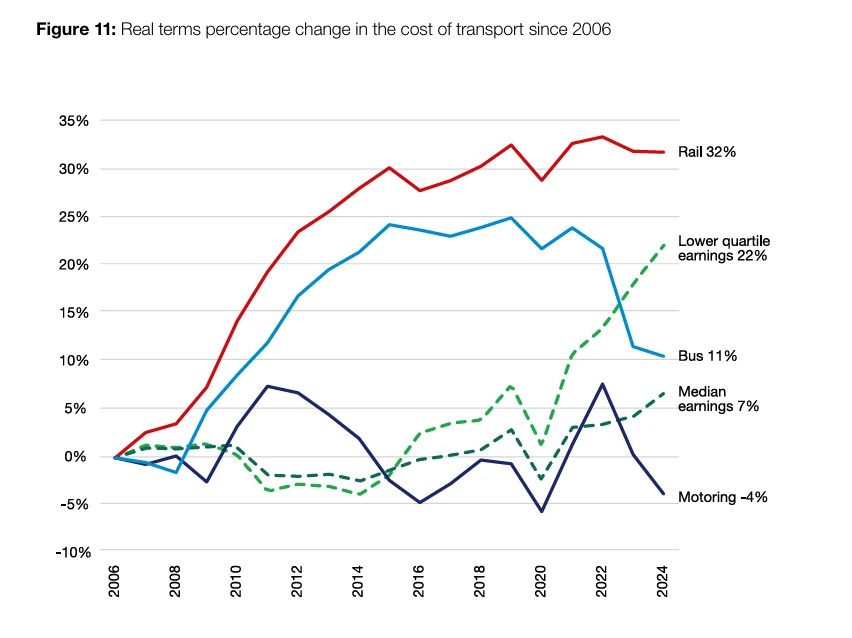
DRIVING UP CONGESTION? Deep in the Government’s new integrated transport strategy is a truth at odds with the rhetoric you hear in the media: driving a car has gotten cheaper in real terms, while public transport has gotten more expensive. The Government is also clear that this will mean more traffic and more congestion. Since 2006 train fares have increased by 32%, buses by 11% (from a pre-pandemic peak of 18%), while motoring costs have dropped by 4%. In less than a decade, the government predicts, road traffic will expand by 10%.
LTNs ARE POPULAR ACTUALLY. LTNs became a culture-war battleground but the evidence now is that people rather like them, says Times columnist Emma Duncan. LTNs have followed a now-familiar trajectory: from “Nazi experiments” and “climate lockdown” conspiracy theories to… actually quite popular bits of street design. Using Oxford as the case study, the piece cuts through the noise to show what’s really happened: traffic inside neighbourhoods falls sharply, it doesn’t meaningfully flood boundary roads, and the predicted collapse of local businesses never quite materialises. What does happen is quieter streets, safer walking and cycling, and kids playing out again. LTNs have been a useful reminder that if you let culture wars or endless consultation dictate transport policy, you’ll never change anything at all.
ALARM OVER DRIVING STANDARDS. Professor Sally Kyd is a leading expert in driving offences and sentencing. In this Guardian piece she underlines the fundamental flaws in the current system that allows killer drivers to walk away with short sentences and limited driving bans. Even when a driver creates multiple risks (driving under the influence while speeding and using a mobile phone, for example), their behaviour can be classed as ‘careless’, not ‘dangerous’, with lower maximum penalties. Kyd argues the concept fundamental to these offences, of a ‘competent and careful driver’, has no shared meaning, while the standard of driving appears to be falling - thanks in no small part to roads policing cuts. Add to that distracting in-car digital screens, and you’re asking for trouble, she says. Kyd argues to redefine driving offences, re-invest in roads policing and to reframe speed cameras and enforcement as life-saving measures, rather than inconveniences for drivers.
SELF-DRIVING SURGE. If you’re looking to cut congestion, then ushering in vehicles that are, by their nature, constantly circulating on the roads, is a bad idea. CityLab’s David Zipper has warnings, in the face of America’s Autonomous Vehicle (AV) boom (also on the cards here - taxi licensing laws permitting). As Waymo’s and Zoox’s vehicles fill San Francisco streets, trends are emerging. People are willing to pay more to sit in one, i.e., they prefer it; they also mind less if congestion worsens - they aren’t driving. AVs also tempt people from public transport, walking and cycling - replacing them with single-occupancy cars. Last week saw traffic jams in China when 100 AVs malfunctioned en masse. Zipper advocates for road pricing to help prevent this gridlocked future - before it manifests.
OTHER HEADLINES
HOW LONG IS AN ACTIVE SCHOOL TRIP? Research, encompassing data from almost half a million children globally, has established how far children will travel by cycling or walking. Across a number of studies, researchers identified mean walking trips of 1km (14 minutes), and mean cycling journeys of 2.7km (13 minutes). This is useful because it helps establish school journeys that are achievable by active means, and can potentially switch from driving. Of course, distances will differ, family to family, and between contexts (climate, culture, infrastructure) but it’s a useful benchmark.
INTERESTING GRAPH OF THE WEEK: Claims there’s a war on drivers fall flat when we remember just how much driving costs all of us. We all subsidise this mode of travel with fuel duty freezes among other things, which is why costs haven’t increased where other transport modes have, and our absolute reliance on cars does more harm than good in congestion, health and the economy. It also leaves us vulnerable to fuel price shocks. Source: https://www.gov.uk/government/publications/better-connected-a-strategy-for-integrated-transport
ACTIVE TRAVEL WORD OF THE WEEK:
“Dangerous” or “Careless” driving? By law, the distinction between careless and dangerous driving is driving that falls either ‘below’, or ‘far below’ the standard of ‘a competent and careful driver’. What competent and careful means, as Prof. Sally Kyd points out this week, is wide open to interpretation and needs clarifying - not least because our ‘motornormativity’ means we accept much riskier behaviour when we are behind the wheel.
Correction: Last week’s deliberate (ahem) April 1 mistake was of an order of magnitude. The London Cycling Campaign’s eagle-eyed Tom Bogdanowicz correctly pointed out that Paris has 1,500 new kilometres of cycle lane since Anne Hidalgo’s inauguration, not 15,000km.
Until next time,
Adam Tranter
CEO, Fusion & Founder, #BikeIsBest
This newsletter is brought to you by Fusion, the agency for movers, specialising in communications and public affairs for active travel and mobility.