


This week, a heat dome has been trapping warm, still air across Europe. There’s good news from London, though, where deaths from polluted air have fallen by 40% in five years. Worryingly, most people seem to accept SUVs, despite the greater risks they pose. Meanwhile, Glasgow’s cycling progress faces a check, and Oxfordshire looks to ban pavement parking.
BIG STORIES FOR CYCLING ADVOCACY
HEATWAVE A heat dome is once again over Europe, bringing prolonged high temperatures through the night. With every heatwave the cries seem to grow louder - that acres of unshaded tarmac is a trend we need to reverse, with tree planting among other things. We also need to cut carbon and, with domestic transport responsible for 28% of the UK’s CO2 emissions, cycling is one low-carbon solution. The heat is making cycling more challenging for now - from everyday journeys people are being recommended to do at cooler times, to the ultra-distance, as Lael Wilcox was forced to abandon her round the world cycling record attempt. For some, though, cycling is still the best option - as Wheels for Wellbeing’s Kate Ball points out.
BATTERY SWAPPING FOR DELIVERY RIDERS Battery fires from low-quality e-bikes that don’t meet legal safety standards are a concern for gig economy riders worldwide. One solution is fire-proof charging facilities, as seen in New York and Amsterdam. Now, Berlin has two such charging cabinets, which riders can use to charge their batteries. The cabinets are compatible with ‘nearly all e-bike batteries’ - so long it fits in the cabinet. They save riders carrying spares, and there’s plans to expand the network to 10 locations. Launched with Zoomo, the batteries inside are monitored as they are charging, via BatteryIQ.
WHAT’S WRONG WITH SUVS? Nearly two thirds of British driving license holders don’t understand that SUVs pose a greater danger to pedestrians and cyclists than smaller cars. That’s according to new YouGov polling of 1,838 British driving license holders. Even after being told the facts, just 3.6% of those who intend to buy or lease an SUV say they would change their minds. The work was commissioned by AdFree Cities with Professor Ian Walker at Swansea University. Walker underlines the folly of accepting this trend, unchecked - pedestrians and cyclists have 44 per cent greater odds of being killed when struck by an SUV driver than someone in a smaller car. Researchers recommend weight-based taxation, to improve the appeal of smaller cars.
WHY LONG-TERM FUNDING IS KEY It’s hard to deliver much on a yearly funding basis. With active travel, councils struggle to deliver ambitious schemes if they don’t know how much money they’ll get in subsequent years. Glasgow made good progress on cycling and walking routes - including some impressive bridges. However, reversal of multi-year funding by Transport Scotland in favour of single-year allocations, the scaling back of cycle route delivery ambitions from 270km by 2032, to just 54.4km. Glasgow City Council will focus on connecting existing routes for now. Where did the money go, you might ask? To potholes, is the answer.
LONDON AIR POLLUTION DEATHS DROP BY 40% The predicted number of deaths linked to toxic air has fallen by 40% in the last five years, according to new data. While the research doesn’t isolate the impact of the Ultra-Low Emission Zone, London mayor, Sadiq Khan, says the zone was crucial in cleaning up the city’s air. The estimated premature deaths attributable to air pollution has fallen from a range of 6,400-8,00 in 2019 to between 3,800 and 5,100 in 2024. The research, commissioned by the Greater London Authority and Transport for London, also found harmful fine particulates fell by 28% in this time.
OTHER HEADLINES
OXFORDSHIRE DEBATES PAVEMENT PARKING BAN Pavement parking may be banned by Oxfordshire County Council, pending a debate next week. The government recently gave strategic or upper tier authorities powers to ban pavement parking if they choose - rather than going for a national ban. Despite widespread public support for a ban, this compromise places the onus on local councils to act, and deliver. In Oxfordshire this decision is even more fractured, and if the motion is successful, each pavement will be examined on a case-by-case basis. While it’s a positive step forward for Oxfordshire, this will be a hugely resource-heavy and time-consuming process.
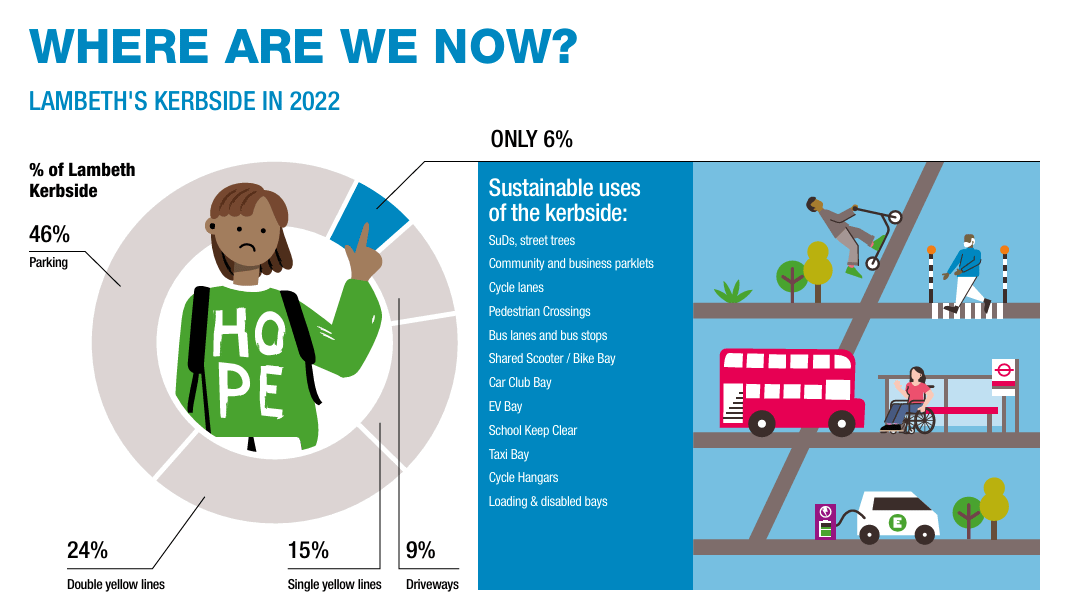
INTERESTING GRAPH OF THE WEEK: This arresting graphic shows just how much space is given over to the parking or control of private vehicles in one London borough (as of 2022) - and how little for more equitable purposes. Extrapolated nationally, that’s a lot of potential for better. Source.
ACTIVE TRAVEL WORD OF THE WEEK:
Kerbside strategy: In Lambeth, south London, 94% of the kerb space is used for car parking. The borough’s groundbreaking kerbside strategy looks at that huge space - 579,000 linear metres of it - and proposes a fairer distribution of that space for things like trees, crossings, cycle parking and seating.
Until next time,
Adam Tranter
CEO, Fusion & Founder, #BikeIsBest
This newsletter is brought to you by Fusion, the agency for movers, specialising in communications and public affairs for active travel and mobility.
