


When road danger makes the news, governments reach for the helmet. New York’s mayor filmed himself buckling one on, France’s ministers floated a mandate, but the real challenge is tackling the danger at the source. Elsewhere there are more reasons why putting people first, rather than cars, is a good thing - particularly for the youngest generation. There’s a promising shift in language around illegal e-motorbikes (rather than calling them e-bikes), 54 organisations use the heatwave to reopen the modal shift argument, cycling gets another celebrity endorsement, and researchers quantify the impact of navigation apps on congestion. It’s a bumper issue, this.
BIG STORIES FOR CYCLING ADVOCACY
MAMDANI’S HARD HAT MOMENT. On August 18th, New York’s mayor Zohran Mamdani posted a video of himself donning a cycle helmet for the first time. While the clip garnered 26 million views and praise, the reality on the ground was far grimmer; within seven days, three cyclists were killed in the city, two of whom were wearing helmets. Streetsblog highlights the core issue: the infrastructure itself is the danger. For instance, a single Brooklyn junction recorded 57 crashes and 29 injuries over five years, while a Bronx intersection saw 120 injuries from 139 collisions since 2022. As Transportation Alternatives’ Ben Furnas points out, helmets offer no protection against two-tonne vehicles. Doug Gordon of The War on Cars podcast noted the poor optics of such a post from an official whose agency actually designs these lethal junctions. Focusing on personal protective equipment is the one safety measure that requires no systemic action from the Mayor himself.
BULLETPROOF VESTS NEXT? On Tuesday afternoon in Paris’s 9th arrondissement, a minor collision escalated into horrific violence when a driver stabbed a cyclist in the neck before fleeing. While the victim remains in critical condition and an arrest has been made, Deputy Mayor Emmanuel Grégoire correctly identified this as “motorised violence.” Advocacy group Paris en Selle noted the grim symmetry with New York: following the high-profile 2024 killing of Paul Varry by an SUV driver—now a murder case—the French government’s primary response has been to consider a universal helmet mandate. “Will it move on to the bulletproof vest?” the group questioned.
HEAT DOME, COLD FEET. Fifty-four organisations, coordinated by Campaign for Better Transport, have used what the Met Office expects to be the UK’s hottest summer on record to reopen the modal shift argument. Transport is the country’s biggest emitting sector at nearly a third of net greenhouse gas emissions, and it rose 2 per cent last year. The ask is specific: binding targets to grow public transport, active travel and shared mobility, and to cut car use. The DfT’s reply listed £2 bus fares, frozen rail fares, £4.5bn for walking and cycling and a £7.5bn zero emission vehicle mandate, but without mode shift targets.
LANGUAGE CHANGING ON ILLEGAL E-MOTOS. It’s an ongoing frustration that the media has tended to conflate legal, safe e-bikes with illegal e-motorbikes, not least when things go wrong. This week the BBC seemed to turn a corner, using ‘illegal e-motorbikes’ discussing the trend of dangerous riding and its impact. A BBC Breakfast piece distinguished e-motos from e-bikes, while Sky News called them illegal e-bikes. This is a positive step forward in a media landscape where, hopefully, journalists and sub-editors better understand the issue.
WITH GREATER POWER… Andy Burnham continues his drive to address what most bugged him in ten years as Greater Manchester’s mayor. This time mayoral authorities are to be given powers to overrule local councils’ planning decisions on larger housing or commercial developments. These powers are essential to enable the strategic delivery of homes and business premises, with a caveat. Developments need to be dense enough, and well-connected enough that we don’t make the same mistakes delivering car-reliant places, and instead enable people to walk, cycle and take public transport instead.
THE CATE GETAWAY. There’s a long-held assumption that celebrities only travel by private chauffeur. David Byrne’s bike ride to the Met Gala, Timothée Chalamet’s Lime biking and now Cate Blanchett’s Brompton getaway after her performance at the National Theatre, show this to be increasingly untrue. These moments achieve widespread coverage but it shouldn’t be unusual for people, celebrities or otherwise, to choose the best tool for the job. The attention is probably welcome, though. In a highly commercialised world, competing against billions in advertising from car brands, showing the benefits of active and public transport to wider audiences is important.
CHILDREN’S FREEDOMS SHRINK. A generation ago British children were allowed to play outside by age ten. Now children are almost 11 before being permitted outside unaccompanied. This is according to a new survey by Play England, of a representative group of 1,974 parents and caregivers of children between ages five to 11. More than half of parents let their charges play out independently at a later age than they themselves did. This generational gap is caused by busy roads limiting children’s safe access to welcoming public space, increased screen use and changing attitudes to children’s independence. Children’s right to play must be recognised, says Play England, and play spaces made accessible for them.
MORE MAPS, MORE PROBLEMS. Urbanists have long discussed the impact of routing apps and services on city streets. Now, research has modelled that impact on three Italian cities. Researchers published in Nature Communications found ‘route recommendations substantially reshape road network usage and CO2 emissions’: as more people used routing apps, fewer roads took the traffic strain. And while at low navigation service adoption CO2 emissions from traffic are reduced, under heavier traffic and navigation usage, emissions can rise. This correlation between greater use of navigation apps and extra strain on limited routes holds, regardless of a city’s individual characteristics.
OTHER HEADLINES
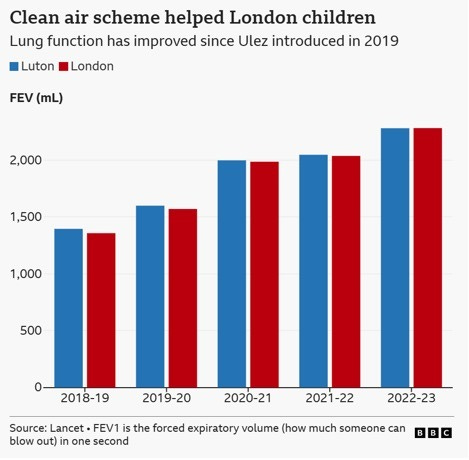
CHILDREN’S STUNTED LUNGS RECOVERING IN ULEZ. Very good news from London last week was the impact of London’s Ultra Low Emissions Zone on children’s lungs. Researchers found young lungs whose growth was stunted by London’s air pollution showed rapid improvements once ULEZ was introduced in 2019. The study compared lung capacity in more than 3,400 children in London and Luton over five years. It is thought to be the strongest evidence on the impact of localised clean air zones during childhood - and underscores the importance of cleaning up dirty air for the next generation.
INTERESTING GRAPH OF THE WEEK: The remarkable recovery of children’s lungs following the introduction of London’s Ultra Low Emission Zone should give every one of us - not least clean air zone detractors - serious pause. Clearly cutting air pollution in cities should be a priority. Source: https://www.bbc.co.uk/news/articles/c1l1r1zne1ro
ACTIVE TRAVEL WORD OF THE WEEK:
National Play Strategy. Play England is calling for the revival of a National Play Strategy, to set out a national commitment to children’s play, and a play-based, rather than phone-based childhood. A Play Strategy was introduced by Andy Burnham as Health Secretary in 2008, before being abandoned.
Until next time,
Adam Tranter
CEO, Fusion & Founder, #BikeIsBest
This newsletter is brought to you by Fusion, the agency for movers, specialising in communications and public affairs for active travel and mobility.

As a child, I instinctively knew that vehicle pollution was bad for everyone. For example, I would always hold my breath if crossing the road in standing traffic.
The welcome but thus far, far too limited implementation of ULEZ zones highlights the continuing intentional ignorance of policy makers, who consistently favour the electorate's desire for everything car, while simultaneously ignoring the health and other benefits of reducing such dependency.
But why stop at just ULEZ? Surely, a congestion charge should be applied to all UK towns and cities, with higher rates for larger, more polluting vehicles. The revenues raised should then be invested in active and public transport improvements, like providing infrastructure which is actually fit for purpose.