


This week, the cycle industry fights back against e-bike misinformation, launching a revamped E-bike Positive Trust Mark scheme to put clear water between safe e-cycles and illegal e-motorbikes. Meanwhile, the drumbeat over the need to tackle our overheating cities continue; rural areas get much-needed guidance for delivering active travel routes and 20mph, which is still considered controversial in some quarters.
BIG STORIES FOR CYCLING ADVOCACY
E-BIKE TRUST MARK LAUNCHES. E-bike Positive has become a trust mark for electric bikes, as research shows 84% of the public can’t differentiate between safe, legal models and illegal e-motorbikes. Launched this week, brands covering 80% of reputable e-bikes sold in the UK are now registered as E-bike Positive suppliers, along with hundreds of shops nationwide. Both shops and brands must commit to the highest product and safety standards. Akin to the Red Tractor food standards mark, the Trust Mark will help reassure consumers they are buying safe, legal products from reputable suppliers.
BAD NEWS FOR E-BIKES ON TRAINS. Meanwhile, MerseyRail has unfortunately followed Transport for London by banning e-cycles on its services. Mark Sutton at Cycling Electric points out some curiosities surrounding this decision: the ban appears to be based on assumptions - dare we say misinformation - rather than fact.
THROWING SHADE. Recent research by a coalition of environmental and horticultural groups urged the British government to significantly increase tree cover and green spaces in urban areas. Green infrastructure, they say, is crucial to mitigating the growing threat of heatwaves in UK cities. Current tree shade is unevenly distributed in urban areas, favouring the wealthier neighbourhoods. This inequality starts early in life, where children in private schools enjoy 41% more tree cover than in state schools. The problem needs tackling urgently, not least to level up children’s access to cooling shade - but a new ‘future homes standard’ excludes schools, hospitals and care homes, and only about a quarter of English councils currently use recognised tools to increase green infrastructure in new developments.
HELPING RURAL COMMUNITIES CYCLE TOO. Rural communities are connected by some of the most dangerous roads in the country, per mile travelled. Cycling and walking are hardly attractive when there’s high traffic speeds and no pavements. New guidance from Active Travel England seeks to help solve the problem by giving rural authorities a suite of tools to deliver active travel routes outside the urban context. The new rural design guide suggests three types of route: those by busy roads, routes using quiet lanes, and those off-road. It takes readers through everything from understanding the kinds of trips taken in rural communities, to developing schemes, designing them and even introducing enjoyable features like play areas, seating and cycle parking. In a nation that’s mostly rural by land mass, it’s an essential bit of kit for local authorities.
STILL RAILING AGAINST 20MPH. There was a predictable hue and cry against the suggestion in new rural design guidance that speed limits on roads shared between walkers, wheelers, cyclists and drivers might be reduced to 20mph, for safety. Shadow transport secretary Richard Holden commented such interventions were ‘nonsensical’, claiming Wales’ speed limit reductions were ‘a disaster’. In fact casualties on 20 and 30mph roads dropped by more than a quarter in the first year, while adding around two minutes to typical journeys. Given speed is one of the biggest contributors to serious and fatal collisions, arguing against it seems increasingly perverse. What’s more, communities are often demanding slower speeds themselves.
OTHER HEADLINES
CYCLING FOR WOMEN’S FREEDOM. Despite patchy growth in cycling in the UK, women are still under-represented in cycling figures. National Travel Survey data finds men make almost three times as many cycling trips as women, cycling four times as far - and the reasons are plain: the roads just don’t feel safe enough. Whether that’s danger from drivers or from potential attackers hidden beside unlit paths, these fears keep women from feeling safe to travel by bike. A recent protest ride around central London, attended by around 300 riders, sought to remind people the problem is far from resolved. Protected cycle lanes, providing routes through busier areas as well as through parks, and tackling poor behaviour on the roads are key.
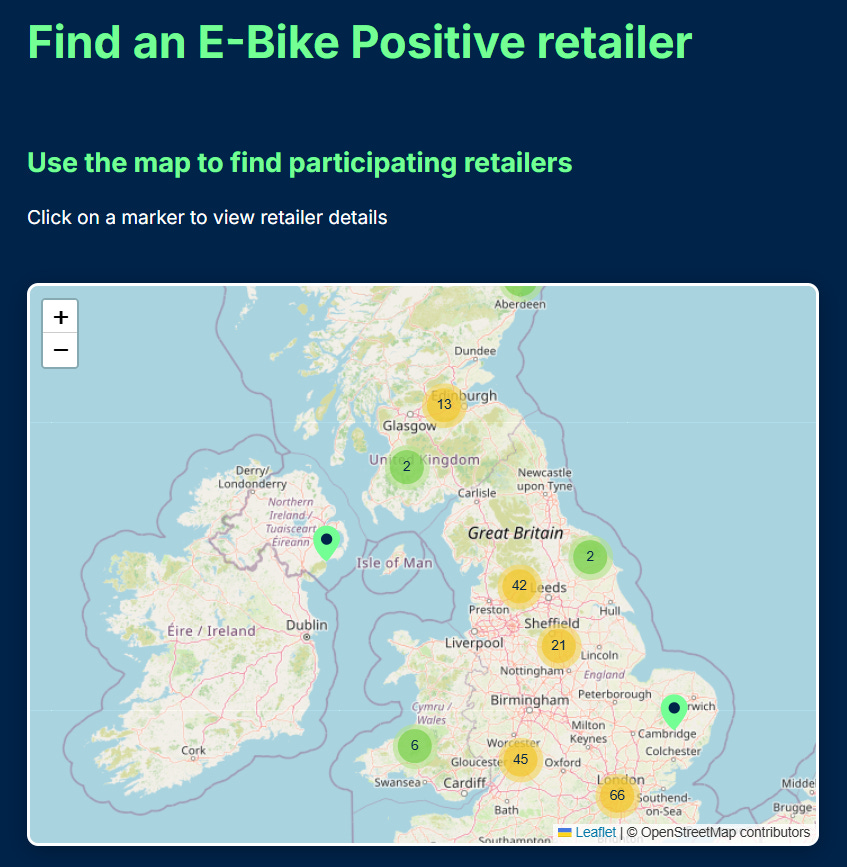
INTERESTING GRAPH OF THE WEEK: E-bike Positive retailers are out there - over 600 at last count - and growing in number. If your local shop hasn’t registered yet, and they deal with e-bikes, give them a friendly nudge. Source: https://ebikepositive.co.uk/pages/retailer
ACTIVE TRAVEL WORD OF THE WEEK: EAPC. The legal term for an e-bike; an electrically assisted pedal cycle. If the rider isn’t pedalling, in almost all cases, it’s not an EAPC. There’s a helpful flow-chart to help distinguish a legal from illegal machin, below. Your local police force may even find it helpful: link.
Until next time,
Adam Tranter
CEO, Fusion & Founder, #BikeIsBest
This newsletter is brought to you by Fusion, the agency for movers, specialising in communications and public affairs for active travel and mobility.
