This week, we’re celebrating having a bike, and preventing someone else from taking it; or at least making a good stab at catching them if they do. Meanwhile, a look at childhood freedoms, the power of local politics in shaping national debate, and the ongoing debate over Hammersmith Bridge.
BIG STORIES FOR CYCLING ADVOCACY
WHAT’S HOLDING BACK CYCLE OWNERSHIP? Less than half of UK residents own a bicycle - the lowest level in Europe. This is according to Shimano’s State of the Nation report, a survey of 250,000 people that reveals cycling attitudes and habits across Europe. Just 87% of UK respondents said they’d ever owned a bike, and for many of them, the reasons were not feeling safe cycling in the UK, and a lack of access to cycle repair and maintenance services. One bright spot for the UK is the improvement in safety perceptions, with 47% saying cycling safety had improved in the past year locally. There’s a webinar on 18 March on this very topic, click to register.
BRITISH TRANSPORT POLICE HEED CYCLE THEFT CONCERNS. Last year cycle-rail commuters were horrified when the British Transport Police announced they would no longer investigate thefts outside rail stations where a cycle had been left for more than two hours or was worth less than £200. This position was problematic for multi-modal travel, which relies on a bicycle still being there on the return leg of a journey. Lobbying by MPs, including in the All Party Parliamentary Group on Cycling and Walking, and by campaigners like Cycling UK, has reversed the decision.
SIMPLE HACK FOR CATCHING THIEVES ON CCTV. As some in the tech space pointed out at the time, there are more efficient ways of identifying a theft that don’t involve hours watching footage of a bike rack. By repeatedly cutting to halfway through the footage to see if the bike is there or not, it is possible to track down the moment of theft in an hour’s footage, in around 10 seconds. The tactic is known as ‘binary search’, which blogger Toni Onodi points out sounds more technical than it is. But it couldn’t be less technical. He even created a tool to demonstrate it.
‘THE PROBLEM IS TOO MANY CARS’. Hammersmith Bridge was the site of protests last month, for and against its reopening to motor traffic, including replacing it with a new four-lane structure. The Times covered the event and campaigner Leo Murray, of climate charity Possible, had a few striking things to say. “Carrying round a two-tonne three-piece suite… with fumes that poison children that live locally, that’s not a God-given right,” he said. Murray also took aim at false flag concerns for emergency service access, saying, “What’s behind the ambulance? It’s a Range Rover”.
DESIGNING OUT CHILDREN. A review of available literature around children’s mobility has concluded that it is street design, and not ‘helicopter parenting’ that excludes access to streetspace among the young. The autonomy that was common in past generations’ childhoods is commonly prevented today by street design, family practices and social norms, the study’s authors say. Slower traffic speeds, protected infrastructure, shorter crossings and simple street layouts are among the design solutions, alongside the reimagining of some streets as play or learning spaces.
OTHER HEADLINES
LOCAL POLITICS IS NATIONAL POLITICS. With local elections coming up in May, local politics is very much on the agenda. Active travel is often hyper-local in its focus - when we’re building bike lanes it’s on someone’s commuter route, while Low Traffic Neighbourhoods impact the very streets where people live. Transport stories are, however, very much national in their reach, as journalists and editors seek to draw out their wider meaning for society. The question often boils down to whether car traffic should be restricted, and what streets are for. Laura, Ned and I try to unpick some of this in our latest Streets Ahead episode.
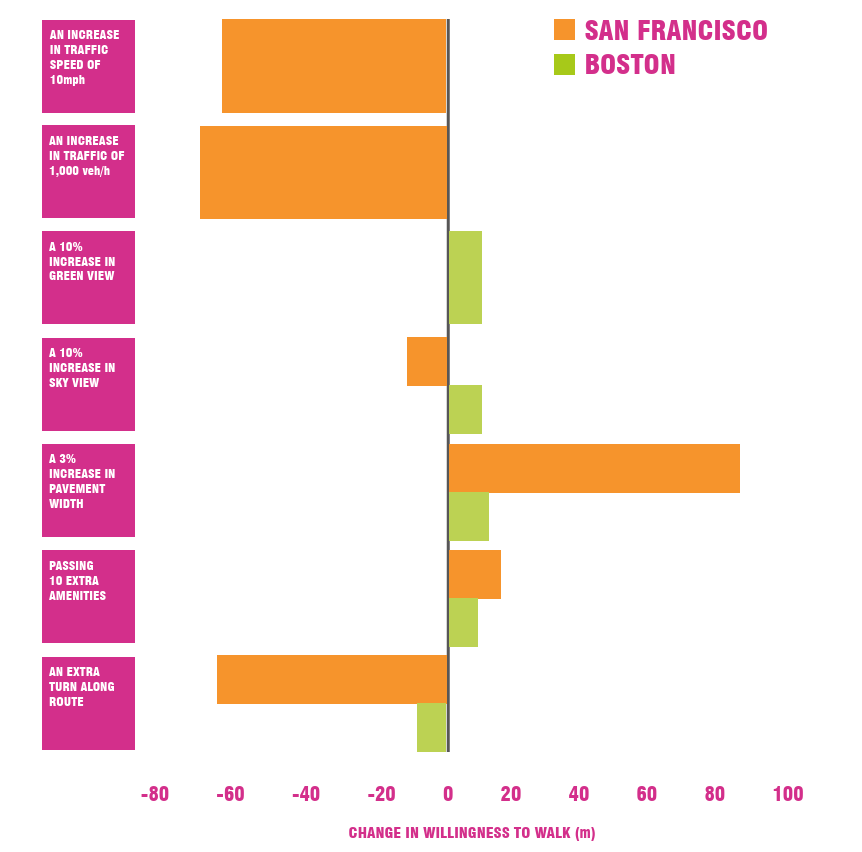
INTERESTING GRAPH OF THE WEEK: Willingness to walk. Convenience, pleasantness, feelings of safety and interest along the way are striking in their impact on how far people are willing to walk. From Living Streets’ Pedestrian Pound report. Source: https://www.livingstreets.org.uk/policy-reports-and-research/pedestrian-pound/
ACTIVE TRAVEL WORD OF THE WEEK:
‘Mobility License’: The extent of children’s roaming freedom, based on their skillset, parental perceptions of traffic danger and community trust. High traffic speed and volume will reduce how far children can travel unaccompanied, while slow traffic speeds and volumes, and protection from that motor traffic, will increase it.
Until next time,
Adam Tranter
CEO, Fusion & Founder, #BikeIsBest
This newsletter is brought to you by Fusion, the agency for movers, specialising in communications and public affairs for active travel and mobility.