


This week, we’re closing off 2025 with some more great active travel news, from what makes cities successful places for cycling, to the human impact of those transport choices, and the many benefits they bring. We hope you’ve enjoyed the newsletter this year - it’s hard to believe we’re getting towards 200 editions of the #BikeIsBest digest.
BIG STORIES FOR CYCLING ADVOCACY
LIVEABLE CAPITALS. Europe’s most liveable capitals might be a hotly debated topic, but in this piece experts, from London, Barcelona, Copenhagen and Vienna, wax lyrical about their cities. Unsurprisingly, cycling provision features heavily in cities’ positive aspects, as do measures to limit car dominance and, of course, access to green space. Ultimately, the way we travel creates - or reduces - various risks to our health and wellbeing, from cradle to grave. How cities tackle those risks, or ignore them, does not go unnoticed.
CONNECTIVITY, MAPPED. “Historically, it has been difficult to measure what a sustainable location is in transport terms,” TransportXtra points out. A new Department for Transport tool quantifies how accessible different parts of the UK, and their homes, services and jobs, are by walking, cycling and public transport. On a map the bright red of inner-city areas and conurbations, (connectivity scores 80 or above), are juxtaposed starkly with rural scores of just one. It is hoped that professionals can use this data to build in well-connected areas, and to improve transport provision where needed.
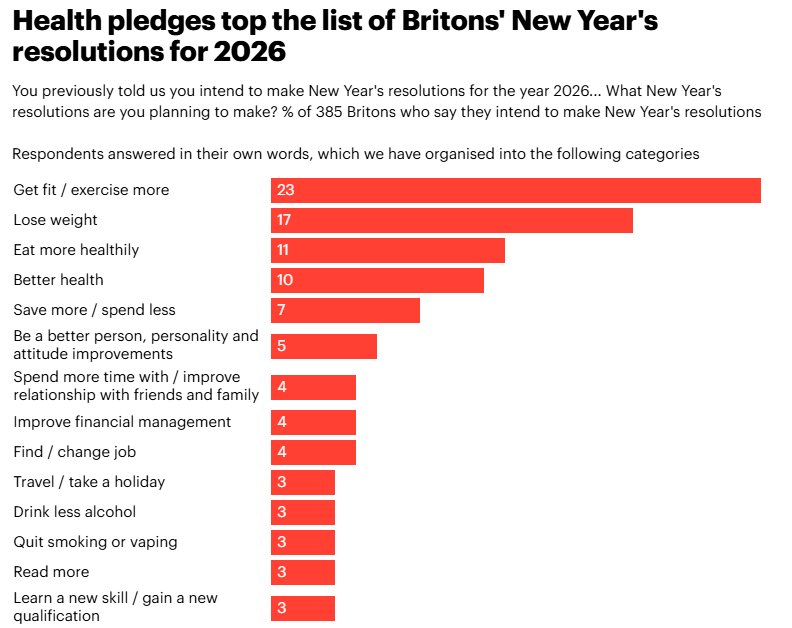
NEW YEAR RESOLUTIONS… Of course, getting active is among Brits’ resolutions for 2026 - for 23% of people, in fact, according to a recent YouGov poll. Younger Britons are more likely to make an annual promise to themselves, with getting fit or exercising more topping the list, followed by losing weight (17%), eating more healthily (11%), and better health (10%). Cycling and walking could help deliver almost everything Brits say they want to achieve in 2026 — if we design streets to support them. For all of the above, enabling active travel quietly does all of it (with no gym contracts).
LTNS - WHO BENEFITS? Decisions to prioritise motor traffic have knock-on consequences, unequally felt. While disabled people’s needs are cited by both sides of the Low Traffic Neighbourhood debate, little research has been conducted. New research examines video footage from three inner-London LTNs, before and after implementation, alongside interviews. While there was no marked increase in disabled users in this small study, improved footways seemed to help people’s qualitative experience of the street, making journeys less effortful, increasing road crossings by mobility aid users and greater use of the road - which can be smoother than the footway. People felt safer, too - though new trees sometimes narrowed the pavement too much - making the case, I’d argue, for trees (and EV chargers while you’re at it) placed in the road.
WHY WE RIDE. The voice of young people is often forgotten in the noise around transport - and this charming video lets us hear those voices. Featuring Cambridge’s youngsters, and their variety of machines, a spoken word piece is followed by different young people’s perspectives on the pure joy and freedom cycling gives them. As well as some of the challenges. A great reminder of the reason many of us still ride, whatever our age.
OTHER HEADLINES
SOME DOWNTIME VIEWING. Ingwar Perowanowitsch is a journalist and filmmaker and this is his film about a long ride from Freiburg to Copenhagen, via Paris, Ghent, Utrecht and Amsterdam. Along the way he shows us some footage of his adventures and interviews people on park benches. With the latter he discusses cities, and what he calls the transport transition. After years of writing about the subject, he decides storytelling is the way forward, specifically a film.
INTERESTING GRAPH OF THE WEEK: Just some of the top New Year’s resolutions people set themselves. Source: https://yougov.co.uk/society/articles/53756-what-new-years-resolutions-are-britons-making-for-2026
ACTIVE TRAVEL WORD OF THE WEEK:
Qualitative or quantitative research: If we’re talking about infrastructure, qualitative research measures the experience of users, while quantitative research looks at the numbers. Both are important.
Until next time,
Adam
Adam Tranter
CEO, Fusion & Founder, #BikeIsBest
This newsletter is brought to you by Fusion, the agency for movers, specialising in communications and public affairs for active travel and mobility.

Comment to BikelisBest
AFTER LOSS of 35MB i NOW can send a Comment !
IN January 2017 , i made several
SAFE PASS MATS , in the same design as was being USED by the
Duo of Police Constables in the West Midlands Police Force , that were subsequently COPIED by the Majority of UK Police Forces , as well as those in continental Europe !
Having OFFERED these by EMAIL to the
NSW Police Force Training Facility
and
Victoria Police Force Training Facility
I received NO REPLY !
No doubt , IF , they HAD BEEN USED for TRAINING Police , the LAWS of SAFE PASS Enacted in later years , would have been
MORE FULLY UTILISED , and , MANY LIVES SAVED !
At that time , i my contention was , that
ANY COMPANY , that had premises for Parking THEIR VEHICLES and Staff Vehicles ,
should have , close to the EXIT , a Permanent SAFE PASS Display , so that ALL Staff would be
DAILY reminded of THEIR Responsibility towards ,
VULNERABLE ROAD USERS !
WMP spent about $A2000 making their Mat !
i Spent $A50 on Gardening Materials to make THREE !
Depending on the materials USED and the
DESIRE of the COMPANY , be it , Council , Bus Operators , Transport or Trucking , or even Vehicle Rental Enterprise ,
ANY COST , is TAX DEDUCTABLE , but , maybe , could
AVOID charges of VEHICLE MANSLAUGHTER , IF , any Employee FAILED to Pass Safely a V R U in their Employment ?
WILL YOU be able to get THIS IDEA , into circulation via YOUR Blog ?
697111
AFTER LOSS of 35MB i NOW can send a Comment !
IN January 2017 , i made several
SAFE PASS MATS , in the same design as was being USED by the
Duo of Police Constables in the West Midlands Police Force , that were subsequently COPIED by the Majority of UK Police Forces , as well as those in continental Europe !
Having OFFERED these by EMAIL to the
NSW Police Force Training Facility
and
Victoria Police Force Training Facility
I received NO REPLY !
No doubt , IF , they HAD BEEN USED for TRAINING Police , the LAWS of SAFE PASS Enacted in later years , would have been
MORE FULLY UTILISED , and , MANY LIVES SAVED !
At that time , i my contention was , that
ANY COMPANY , that had premises for Parking THEIR VEHICLES and Staff Vehicles ,
should have , close to the EXIT , a Permanent SAFE PASS Display , so that ALL Staff would be
DAILY reminded of THEIR Responsibility towards ,
VULNERABLE ROAD USERS !
WMP spent about $A2000 making their Mat !
i Spent $A50 on Gardening Materials to make THREE !
Depending on the materials USED and the
DESIRE of the COMPANY , be it , Council , Bus Operators , Transport or Trucking , or even Vehicle Rental Enterprise ,
ANY COST , is TAX DEDUCTABLE , but , maybe , could
AVOID charges of VEHICLE MANSLAUGHTER , IF , any Employee FAILED to Pass Safely a V R U in their Employment ?
WILL YOU be able to get THIS IDEA , into circulation via YOUR Blog ?