


This week, the growing problem of illegal e-motorbikes is evident not only here in the UK, where commuters are turning to dodgy products, but into Europe. Streets Ahead shadows the City of London’s cycling team catching e-motos. Meanwhile, the EU industry calls for a crackdown on non-compliant products and their knock on effect on road safety, cycling uptake and the regulated industry. In happier news elsewhere, cycle lanes are up and traffic lanes and parking are down.
BIG STORIES FOR CYCLING ADVOCACY
EU INDUSTRY CALLS FOR ACTION ON E-MOTOS. The problem of non-compliant e-cycles isn’t restricted to the UK, sadly. Now, European Cycling Industries (ECI) is calling for the European Union to do more to protect consumers and the industry. E-cycling is one of the European success stories but as in the UK, illegal models are harming not only users but confidence in the industry and therefore the shift to healthy, sustainable transport. Echoing calls in the UK, they want to ban sales of tampering kits, to establish evidence on the impact of non-compliant models on safety and the industry, and to empower enforcement agencies.
POLICE SELL SEIZED E-MOTORBIKES. E-motorbikes are a growing scourge on Britain’s streets, as online marketplaces profit from a ‘private land’ loophole allowing such bikes to be sold with a wink. Given the lack of access to private land in England it’s likely the vast majority of these machines end up on Britain’s roads. So it’s frustrating that a BBC Freedom of Information request revealed 161 e-bikes and e-motorcycles seized by police were then sold at auctions. While some forces defended the practice as helping fund police efforts, the fear is they are simply being bought by criminals to continue the cycle of misuse, as it were - making more work for police.
INSIDE CITY POLICE E-MOTO CRACKDOWN. With news in the UK that even commuters are turning to illegal e-motos, Sergeant Stu Ford and his team in the City of London Police are out to catch them. For the latest Streets Ahead episode, Laura Laker and Mark Sutton shadow Sgt Ford and his officers to find out what it takes to tackle the growing problem of non-compliant e-cycles on Britain’s streets. From delivery riders to commuters to criminals, we hear about the ever-evolving game of cat and mouse forces have to play to bring in these products, which are still sold legally in the UK, despite not being road legal.
BARCELONA TACKLES PARKING GARAGES. Another crucial pillar in enabling the shift away from cars to cycling in cities, is tackling parking minimums (see word of the week) in new developments. While it may sound policy wonkish, parking costs everyone money, drives up housing costs and uses space that could be used for trees, play space, walking and cycling. Each surface parking space can cost €3,000-€5,000 to build, or €10,000 to €20,0000 for each multi-storey or underground space. Barcelona is the latest global city to cut parking minimums in new developments to promote sustainable mobility, and ease housing costs. It joins cities like London, Amsterdam, Oslo, Bremen in Germany and Mechelen in Flanders.
TRAFFIC DOWN, BIKING UP IN NYC. 100 years ago the New York urban planner, Robert Moses, demonstrated that expanding urban highways generated huge volumes of motor traffic (not that it stopped him building more). Now opposing pressures are at play, and it’s good for cycling. Mayor Mamdani’s administration is capitalising on a drop in traffic from congestion pricing to introduce cycle lanes and widen walking space in west Queens. Thompson Avenue will see two traffic lanes replaced with a two-way protected cycle lane and additional sidewalk width, connecting to an existing protected bike lane on Queens Boulevard and providing a much-needed protected crossing over a railway.
OTHER HEADLINES
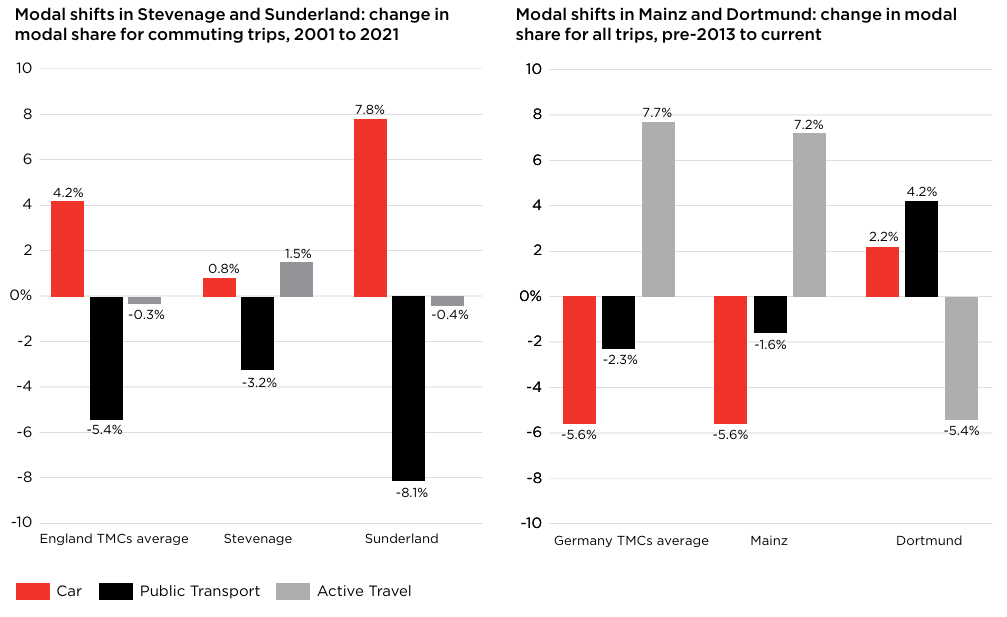
A CASE FOR AVERAGE CITIES. We’re used to hearing stories from cities with the biggest cycling levels - but what about the average cities, just quietly getting on with it? Research by LSE Cities looks at German cities where 11 per cent of people cycle, versus England’s 2 per cent. In the past two decades, it found, German cities have shifted away from driving, while cycling has risen sharply. This was a result of planning decisions centring jobs, retail and services in city centres with sustainable transport options. Infrastructure was key, but not the whole picture - Stevenage shows us those networks need to be direct, fast, and convenient - as well as safe. Dark underpasses in isolated areas won’t help more people cycle.
INTERESTING GRAPH OF THE WEEK: A fair bit going on in these two graphs but they illustrate how in UK cities driving is going and cycling down, while in German cities the reverse is true (Dortmund aside, which bucks the German-wide trend). The difference comes down to who urban planners prioritise. Source: https://www.lse.ac.uk/Cities/Assets/Documents/Typical-Mobility-Cities/Learning-from-Cities-with-Typical-Mobility-Policy-Brief-LSE-Cities-final-May-2026.pdf
ACTIVE TRAVEL WORD OF THE WEEK:
Parking minimums. The minimum level of parking required in planning regulations for new developments. The late great Donald Shoup rightly blamed parking minimums for everything from urban sprawl to the high cost of housing. Many cities are starting to realise Shoup was right, and are reversing these policies.
Until next time,
Adam Tranter
CEO, Fusion & Founder, #BikeIsBest
This newsletter is brought to you by Fusion, the agency for movers, specialising in communications and public affairs for active travel and mobility.
