


This week, we’ve an array of stories ranging from tackling antisocial and dangerous driving, to dealing with councils who pull out cycling safety measures. The government hopes to tackle ‘consultation culture’ that stops real change happening on the ground, while delivery riders are calling on firms like Deliveroo to reveal the mysteries of ‘black box’ algorithms that dictate their working lives.
BIG STORIES FOR CYCLING ADVOCACY
AN END TO CONSULTATION CULTURE? Consultations are valid ways to help gauge public opinion, hear and mitigate genuine concerns. However, a culture of endless consultation can displace actual decisions being made on the ground. A memo, sent from the top of government to ministers this week, seems to recognise this problem. It says ‘consultation culture has turned a sensible mechanism for sourcing external input into an industry of dither and delay, which fails to hear from those whose perspectives are most relevant…and can drag policies to a lowest common denominator outcome’. It will be interesting to see how ministers interpret this in the government’s drive to simplify, and enact change.
GIG WORKERS CHALLENGE DELIVERY APPS OVER TRANSPARENCY. For delivery riders operating on gig economy platforms, algorithms are a silent but ever-present influence on their working days. These AI-driven systems determine which riders are offered which jobs, and how much they are paid. Workers in Edinburgh say their pay has declined by as much as half, as algorithm use has increased, and have teamed up to ask delivery platforms to open up the ‘black boxes’ that make the decisions. They are operating through the Workers’ Observatory, a charity set up by gig workers and academics to help research and challenge working conditions.
TFL’S WARNING SHOT OVER BIKE LANE REMOVAL. Transport for London has frozen Croydon’s £2m transport funds after the council dismantled a TfL-funded bike lane without permission. This is also seen as a warning to other boroughs. Strategic transport plans in London are agreed between the mayor and councils, via things called LIPs (Local Implementation Plans). These are legally-binding documents with funding attached to specific schemes. In Tower Hamlets, mayor Lutfur Rahman’s plans to remove LTNs were legally challenged by local campaigners for breaking LIP agreements. Rahman’s appeal is currently with the Supreme Court.
WHO ANSWERS FOR ROAD SAFETY? While it’s right that we should expect hire bike users to comply with the rules of the road, the disproportionate media focus on them and the companies running them is curious. The Financial Times has been counting cyclist behaviour on the streets of London, and found 43% of hired e-bike users jumped red lights, plus a third of ‘conventional cyclists’. While this behaviour is intimidating and irritating for other road users, it’s worth pointing out the column inches dedicated to this topic seems inversely proportional to relative harm, vs law-breaking driver behaviour. What of car manufacturers producing oversized ‘urban’ vehicles that can reach 60mph in seconds, with top speeds of over 90mph?
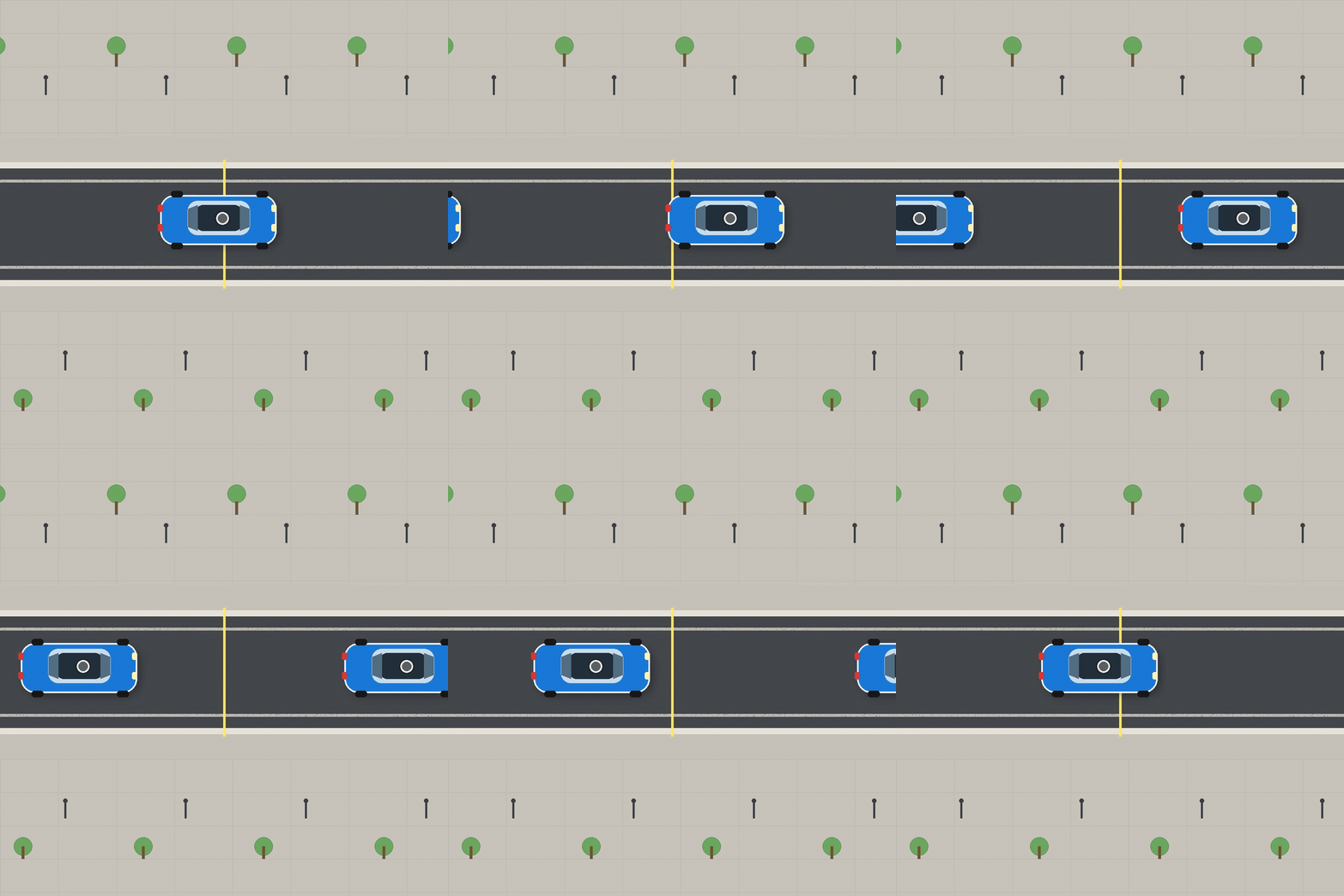
ROBOTAXIS - TAKING UP SPACE. Photos of Uber and Wayve’s robotaxi launch event highlight just how space inefficient cars are in cities. In one picture, around 100 people surround two of the autonomous taxis. What if all of them took a robotaxi to the event? In the US the vehicles usually have one person in them which, with the roughly 44% of Waymo mileage that’s ‘deadheading’, i.e., empty, equates to 179 vehicles for 100 people. Travelling at 20mph with around 2.5 seconds between them, that crowd alone would create eight minutes of unbroken traffic, 3.5 minutes of which are empty vehicles. Is this really the future of urban transport? If so, it’s not a future we’d actually want.
OTHER HEADLINES
THE CASE FOR UPPING PARKING FINES. The cost of parking a private vehicle rarely reflects the wider costs to society, while fines often fail to deter antisocial parking. In a recent trial, Bournemouth, Christchurch and Poole Council were allowed to put up parking fines to London rates. The impact, according to Danny Williams, was that parking fines on one seafront road fell 92%, in a trial supported by 76% of businesses, where bus journey times also improved. Williams argues for new council powers to tackle pavement parking, borough-wide, to include inflation-linked fine structures, to ensure the measures have teeth.
INTERESTING GRAPH OF THE WEEK: If you think Robotaxis are a good idea for urban transport, please watch this animated GIF for seven minutes, 52 seconds. That is 179 cars at 2.64 seconds intervals, 473 seconds in total. You’ll have plenty of time to figure out why the traffic is so bad.
ACTIVE TRAVEL WORD OF THE WEEK:
Ghost plate. A vehicle registration plate that can’t be read by standard ANPR cameras, thanks to raised digits that appear ‘see-through’ in cameras, or via reflective films or sprays. A new National Roads Policing Co-ordination Centre (NRPCC) has been set up to tackle the problem, which allows drivers to drive dangerously, commit crimes and evade police. Among their toolkit is a special set of goggles to confound ghosting efforts.
Until next time,
Adam Tranter
CEO, Fusion & Founder, #BikeIsBest
This newsletter is brought to you by Fusion, the agency for movers, specialising in communications and public affairs for active travel and mobility.
