


This week, there seems no end in sight to global uncertainty and fluctuating oil prices adding to an already chronic cost-of-living crisis. Naturally, people are looking seriously at alternatives to driving for every trip. From how to push for traffic-free infrastructure, to bringing a bike out of dusty retirement, the bicycle is, once again, offering one solution in a time of many problems.
BIG STORIES FOR CYCLING ADVOCACY
CYCLING BACK IN THE HEADLINES. Australia is one of the most car-dependent nations on Planet Earth. In this Guardian Australia piece, readers are reminded of the power of their bicycles to ditch the car, save them money and bring the joy back to everyday journeys. Alan Vaarwerk offers some helpful tips on bringing a bicycle back into service - as well as how to find routes, build confidence and even meet other riders in your area. Latest calculations are, an e-bike is 140 times cheaper per mile than a petrol or diesel car.
AND IN COUNCILLORS’ INBOXES? Local people should not be the ones delivering safe cycling and walking routes - after all, it wouldn’t happen for road or rail infrastructure - but this is the situation we find ourselves in. My podcast co-host, Laura Laker, has produced a helpful campaigners’ toolkit, sharing some of the expertise of successful rural campaign groups. She also reveals that landowners are holding up around 300 miles of community-driven path campaigns, and 117 miles of council paths, preventing delivery of safe alternatives to driving.
A WORD FROM OUR SPONSOR. I’m pleased to say that my agency Fusion has been appointed by Active Travel England to support the delivery of their Making Active Places Conference, which will take place on 22nd and 23rd September in Manchester. This is exactly the kind of work that sits at the heart of what we do as the Agency For Movers.
Bringing together the people shaping how our towns and cities move, the conference is an opportunity to turn ambition into action — and to make active travel a practical, everyday reality. Fusion will lead conference management, delegate experience and commercial partnerships. If your organisation is interested in exhibiting at the conference or sponsorship opportunities, do get in touch.
CYCLING AS A STRATEGIC TOURISM SECTOR. The European Cyclists’ Federation has seen cycle tourism included as a strategic sector in Europe’s Sustainable Tourism Strategy. This means the iconic Eurovelo routes are recognised - along with the need to improve and enhance them for local communities, sustainable travel and small and medium enterprises (SMEs). Plus, of course, boosting cycle tourism numbers. Leisure is the biggest reason for making a journey here in the UK, too - above commuting - and cycle tourism is worth hundreds of millions of pounds. With the cost of flights increasing we might be wise to promote cycle tourism too.
WALKING AND CYCLING AS FRIENDS. Tensions between pedestrians and cyclists are not inherent to walking and cycling, but the product of street design. That’s what the author of a brand-new report: Cycling and the Relationship With Pedestrians, has said. With the bulk of streetspace allocated to motor vehicles, Alan Raposo says, everyone else is forced to share the remaining space, often on pavements. Even if physical conflict happens rarely, this setup undermines public perceptions of cyclists, who are seen as risks to pedestrians in shared space. The solution is to treat active travel - both walking and cycling - as proper transport, and not an afterthought. And keep pavements for pedestrians, ideally.
BRIDGE OVER TROUBLED RAILWAY. Work is underway on a new HS2 walking and cycling bridge in Warwickshire. Local connections and crossings in and around railway lines and roads are essential if communities are to have decent transport choices - so it’s great to see this being delivered in and around the HS2 line. A new bridge at Cambridge’s Waterbeach development officially opens next month, too - crossing the busy A10, traffic-free. The easier, and better connected a community is by walking and cycling networks, the more likely people are to use them.
OTHER HEADLINES
STORYTELLING AS A TOOL. Cycling can change lives - from improving health, to saving money, to making everyday trips more enjoyable, there are almost as many stories as there are bicycles. For a bit of inspiration, and knowing the power of storytelling to make change, the social media account, American Fietser, has asked people for their stories. From saving money to finding a community, to joyful school runs, to mental and physical health benefits, it’s all there.
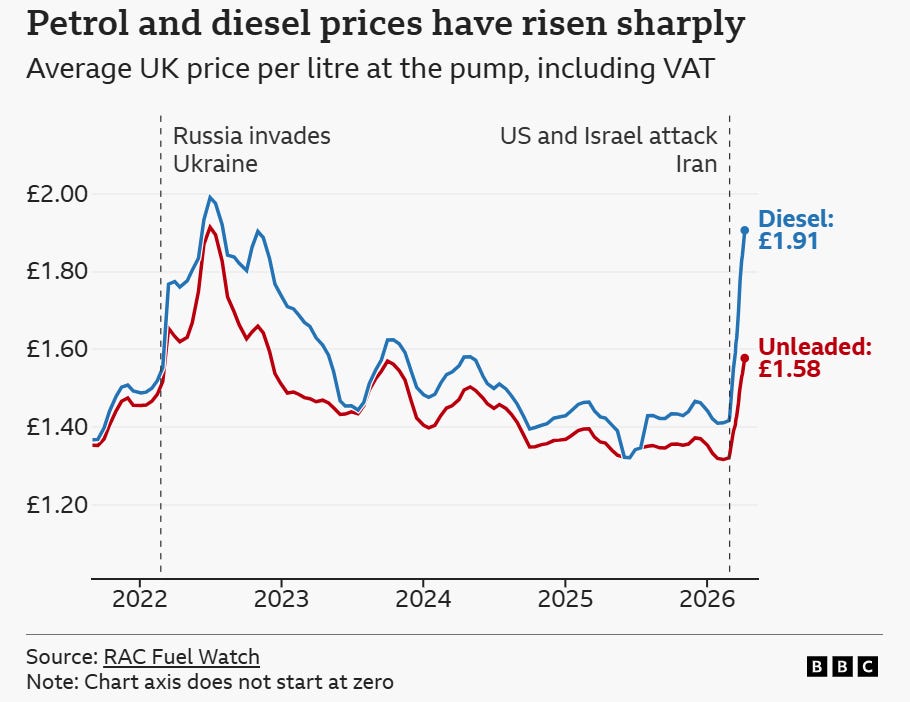
INTERESTING GRAPH OF THE WEEK: A diverse transport system is a resilient one. While there are pockets of good cycling, walking and public transport investment, elsewhere there’s little escaping car dependency, and with it the impact of fuel prices. The recent Better Connected transport strategy should help more people take public transport, but the promised change is urgently needed. Source: https://www.bbc.co.uk/news/articles/c5ywpv1d4geo
ACTIVE TRAVEL WORD OF THE WEEK:
Connectivity. A bit of a buzzword, as the UK government starts to try to knit together means of non-car transport. It even launched ‘connectivity metrics’ last year. This describes how easy it is for someone to reach employment, services and social engagements - and includes walking, cycling and public transport - not just driving.
Until next time,
Adam Tranter
CEO, Fusion & Founder, #BikeIsBest
This newsletter is brought to you by Fusion, the agency for movers, specialising in communications and public affairs for active travel and mobility.

Great content! Love that e-bikes are 140 times cheaper than cars! However, disappointed that the DfT Connectivity matrix doesn’t acknowledge quality or safety or walking and cycling infrastructure, hopefully it will in the future.