This week, we’ve had a glimpse at the uphill struggle local authorities face assembling land for rural paths; the cycle industry braces for a potential Cycle to Work cull and, after a decade of protected route delivery, London sees even more growth in cycling numbers.
BIG STORIES FOR CYCLING ADVOCACY
BIG CYCLING GROWTH IN LONDON. A million and a half cycle journeys a day. That’s what’s happening in London, a decade after the city’s first major protected cycleway was opened. That’s 63% up on 2019. Now, 76% of people using protected routes say they feel safe, as opposed to 40% cycling in general traffic. With just 2.5% of the network comprising cycleways there’s a lot of unmet potential still. Much of that growth has been in central London, but TfL says its work with boroughs to deliver even more across the city.
ELSEWHERE, CYCLEWAYS TO NOWHERE. Laura Laker’s latest Substack post delves into the fact that vanishingly few local authorities use legal powers to assemble land for rural cycle routes - powers they routinely use for roads. The fact that just 2% of councils have used Compulsory Purchase powers, and a similar amount considered Path Creation Orders (to permit public access across private land), points to a problem. Without support, and case studies of success, rural communities will continue being denied access to cycling as a means of getting around, and of exercise.
WHEN TRANSPORT NEEDS TO JUSTIFY ITSELF. A £3,750 EV grant on a £35,000 car is framed as “helping families” and “putting money back in pockets”. But support through Cycle to Work is framed as “subsidising leisure” and a questionable use of taxpayers’ money. Oxford University research shows cycling is ten times more important for reaching net zero cities than electric cars, while HMRC’s own evaluation of Cycle to Work shows it reduces sickness absence, supports lower-income workers and gets more people travelling actively. A £1k cap on C2W now looks likely but it’s worth asking: why are the two modes treated so differently?
CYCLING AND PREVENTATIVE HEALTH. Enabling people who aren’t physically active to move is one of the best ways of improving public health. And one of the best ways to do that is by building the opportunity for activity into their daily lives. Enter: the humble cycle lane and the decent pavement. They may be simple, they may be inexpensive as infrastructure goes, but boy do they deliver on health. This blog post by the Urban Cycling Institute underlines what we’ve long known. It’s well worth repeating.
CYCLING AT COP30? In previous years cycling has been notable by its absence from Conferences of the Parties (COP) climate talks. However, this year, the European Cyclists’ Federation says, it ‘featured prominently’. The Partnership for Active Travel and Health (PATH) coalition and Walk21 joined three official side events and five other events, working with politicians, advocates and civil society organisations to bring active travel up the agenda. They spoke on events around air quality and emissions reductions, and public health and financing. All power to their efforts.
OTHER HEADLINES
CYCLING THROUGH WINTER. Road.cc has updated its annual ‘safe winter cycling’ feature, helping more people keep on riding year-round. From wider tyres with lower air pressure, to pedals to saddle heights, to which layers to focus on, where - it’s a practical guide to keep you safe and comfortable through the icy months. With the very helpful addition of riding tips to avoid a spill in the snow and ice.
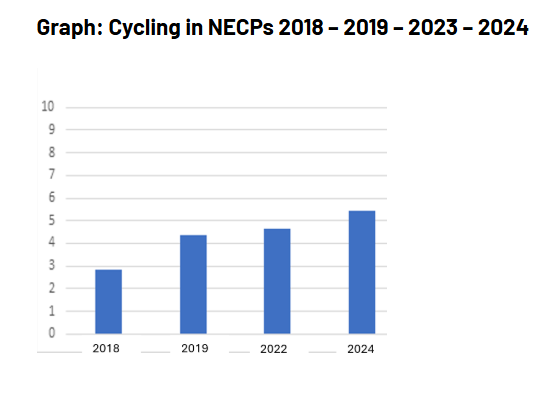
INTERESTING GRAPH OF THE WEEK:
More European nations are including cycling in their National Energy and Climate Plans, recognising its role in cutting transport’s carbon emissions. Source: https://www.ecf.com/en/news/a-glass-half-full-growing-significance-for-cycling-policies-in-final-national-energy-and-climate-plans-/
ACTIVE TRAVEL WORD OF THE WEEK:
Path Creation Order. A legal power for local authorities to designate a footpath or bridleway over land for public enjoyment or convenience - weighed up against the landowner’s needs. A useful but underused way for rural local authorities to create traffic-free walking and cycling paths.
Until next time,
Adam
Adam Tranter
CEO, Fusion & Founder, #BikeIsBest
This newsletter is brought to you by Fusion, the agency for movers, specialising in communications and public affairs for active travel and mobility.