


Public space is political - it could be described as a microcosm of politics, defining who gets what, in the geography of cities. As Barcelona researchers this week wrote, the way our streets are designed isn’t inevitable - it is a choice, and one that often gives most space over to car drivers. The story of urbanism today is one of whether - and how - we reclaim some of that space back for residents of cities, from metal boxes. This week showcases some of that tension, and how cities are responding.
BIG STORIES FOR CYCLING ADVOCACY
FASTER BIKE LANES FOR NEW YORK. Cycle lanes and outdoor dining make cities nicer places to be - and are good for local businesses. New Yorkers have voted to speed up delivery of both. Mayor Zohran Mamdani’s drive to improve delivery of people-friendly measures and boost cycling in the city means cutting bureaucratic hurdles to delivery. This vote permits a reform of laws often used by bike and bus lane opponents to challenge reallocating road space from cars, and acceleration of the outdoor dining application process. One day New Yorkers won’t believe people fought for traffic-dominated streets.
WAYMOS VS SCHOOL BUSES. For robotaxi companies, you’d expect that keeping children safe would be a priority. A large number of the vehicles have been caught illegally passing US school buses that were unloading children. Waymo said they fixed the software problem last November, but federal safety investigators found most incidents have happened since then. The National Highway Traffic Safety Administration is now opening an investigation. You can add these autonomous vehicle misdemeanours to a growing list that includes widespread bus lane violations (BiB #222) illegal parking (#235), and ploughing into a crime scene (#211). Oh, and worsening congestion (#207 and #229). I’m sure Waymo will look into it as soon as they’ve figured out why one of their vehicles went past a rolling road block from California Highway Patrol, as posted on Instagram today.
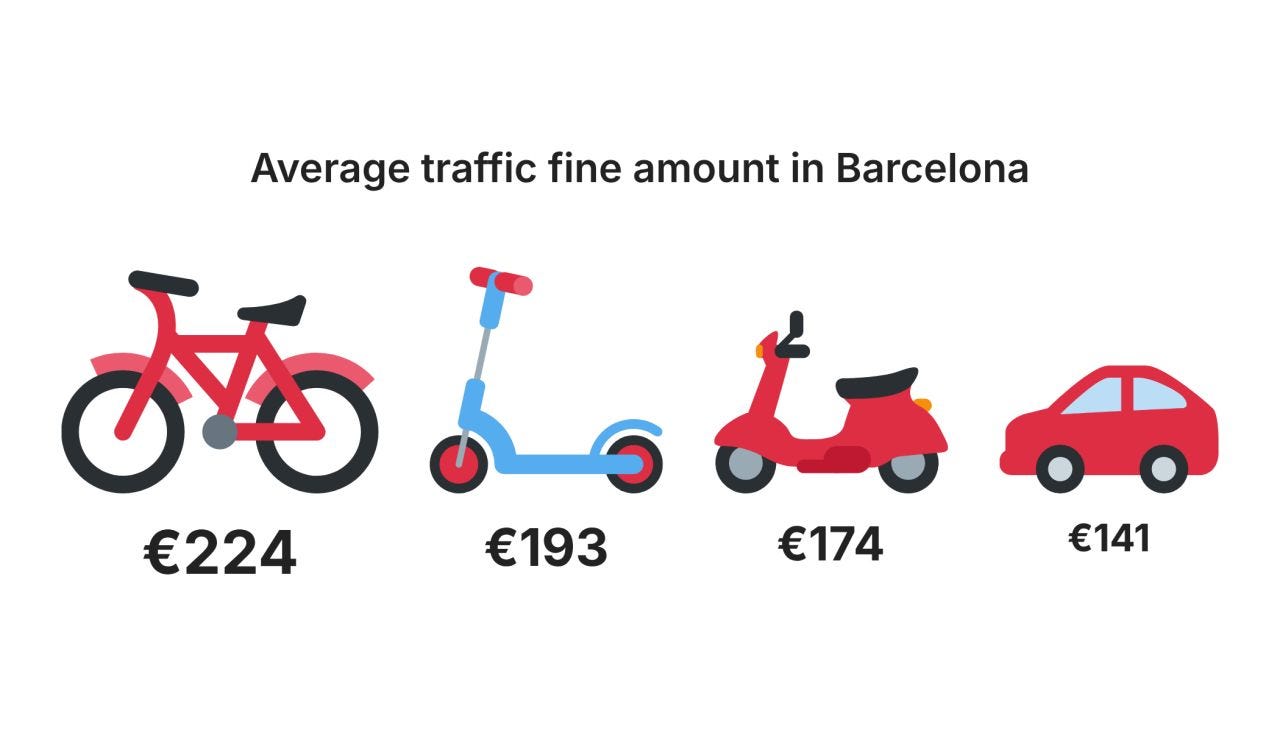
CYCLIST FINES>DRIVER FINES. I wrote last week about the disproportionality on display when we talk about cycling law breaking vs driving. While neither are acceptable there are real double standards at play, with the lesser risk, cyclists, seeing the greatest public scrutiny. Researchers have quantified this problem in Barcelona, finding that while the average driving fine is €141 for drivers, it’s €224 for cyclists. What’s more, cyclists and e-scooter riders were fined more often, receiving 32% of fines, despite being just 13% of traffic. One researcher says the findings reflect a motornormativity bias in action.
ROBOTS ON THE ROAD. While some companies are looking at pavements as autonomous delivery infrastructure, making lives harder for pedestrians, it’s good to see others choosing roads instead. London-based tech firm, Minimal, has launched its first (roadgoing) delivery robot, ‘Bot’. As Zag Daily reports, Bot has a capacity of 0.8m3, is assembled in West London and can take multiple orders in one run. This is a much more equitable model than introducing motorised vehicles to already contested pavement space - keeping roads for deliveries and pavements for walking and wheeling trips.
SPEAKING OF WHICH. Keeping pavements free from clutter is crucial for accessibility, no matter the cause of the blockage. So it’s welcome that the Department for Transport is consulting on standards and powers for local authorities to manage, among other things, dockless cycles. Shared micromobility is a key part of the modern transport mix but it needs managing sensibly. We also need to take a leaf from New York and speed up the process of designating on-road bays, so pavements blocked by parked bikes becomes a thing of the past.
OTHER HEADLINES
BUS STOP BYPASSES IN FIRING LINE. Bus stop bypasses are in the international toolbox of integrated cycle and bus networks - but they aren’t perfect. This week the London Assembly recommended pausing their installation following a number of incidents involving blind, partially sighted, older and disabled Londoners experiencing near misses or being hit by cyclists while getting on and off buses. Meanwhile, the London Cycling Campaign points out in a blog that while they could be improved, they are essential for the majority who don’t want to mix with 13-tonne buses, which is one of the alternatives. As always, it’s not a straightforward issue and needs a considered approach, not a ban.
INTERESTING GRAPH OF THE WEEK: The inverse proportionality of fines for Barcelona’s road users, vs the risk they pose. Source: https://www.linkedin.com/posts/samuel-nello-deakin-4b3b64b2_average-traffic-fine-amount-in-barcelona-share-7524403259508170752-p-cp/
ACTIVE TRAVEL WORD OF THE WEEK:
Street space allocation. The politics of urbanism and the public realm: who, or what, gets a share of a city’s streets - and how much of it they are given (or indeed take).
Until next time,
Adam Tranter
CEO, Fusion & Founder, #BikeIsBest
This newsletter is brought to you by Fusion, the agency for movers, specialising in communications and public affairs for active travel and mobility.
