This week, we’re seeing oil price shocks and cars in tunnels. Meanwhile, e-bikes are coming to the rescue, police are coming to remove the fake e-bikes, the same police force are moving away from their dedicated cycle safety team and we’re heading back to the 1880s and a very particular cycling craze. Confused? I like to keep you on your toes.
BIG STORIES FOR CYCLING ADVOCACY
E-CYCLES PROTECT FROM OIL SHOCKS. The war-induced fuel shocks are driving motoring costs up, and the AA and RAC have advised people to cut back on non-essential journeys to conserve fuel. Cycling costs aren’t at the mercy of such global events and Cycling Electric’s Mark Sutton points out in his usual thorough manner that not only do e-cyclists save money, but also their health and time stuck in traffic. Sutton concludes that there’s a strong case for e-bike subsidies, as there are for electric cars, to help more people reap the benefits.
LTN FEELINGS - AN HONEST ANALYSIS. It’s fair to say Low Traffic Neighbourhoods inspire mixed feelings. 528 of Oxford’s LTN residents filled in surveys, with 30 in-person follow-ups, and 15 journeys were undertaken with residents. Those 30 individuals’ responses revealed dramatic improvements to the local environment, safety, including for children, and feelings of community. Interestingly, the behaviour of drivers was commonly cited as a problem with the LTN, plus perceptions the schemes unfairly favoured people cycling. There was also a disabled resident who found driving harder after the implementation. The answer is surely to tackle driving issues more widely, and try to help disabled residents who drive.
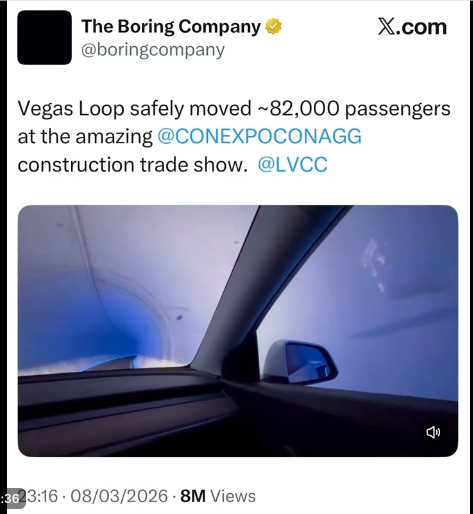
HAVE YOU HEARD OF MASS TRANSIT? In case you didn’t already know: cars in tunnels aren’t the future of transit. This week, Elon Musk’s Boring Company has been boasting on social media about carrying around 82,000 passengers during a five-day expo in Las Vegas. This sounds impressive until you look at the wider context, and compare it with other underground transport systems. By contrast, in London the Elizabeth Line carries ~800,000 people per day. Even Victorian steam trains in 1860s London moved 3–4× more people per hour than Elon.
BEAT COPS BEATING FAKE E-BIKES. Illegally-modified or ‘fake e-bikes’ are a safety issue, on the roads and in the fires they are associated with. As well as that, there is a substantial reputational harm to the safe, regulated industry when what are effectively motorbikes are being confused with safe, legal e-bikes. With Operation Lexand, Metropolitan Police officers are being trained to distinguish between the two, and take the dangerous machines off the street.
SWINGS AND ROUNDABOUTS. There are concerns, separately, that replacing the Metropolitan Police’s dedicated cycle and motorcycle road safety units may do more harm than good. The Met says its new Road Danger Reduction Team will proactively enforce the most serious road traffic offences, taking on the functions of multiple specialist units like the Cycle Safety Team and the Commercial Vehicle unit - the latter being the largest of its kind in Europe. This specialist unit that investigates deaths involving HGVs and London buses being driven in the capital was also axed last month.
OTHER HEADLINES
HEART OF A 19TH CENTURY CYCLING CRAZE. In the 1880s the high street in Ripley, Surrey, regularly drew thousands of cyclists. This short radio piece from Radio Surrey describes the craze. At the time the road had been resurfaced and a new train line was introduced. This meant Londoners could cycle to Surrey on the new safety bicycle or tandem bike - the Penny Farthing was on the wane - on a day ride. More women could ride the new bikes, too, in the voluminous skirts of the day, with less risk of serious injury.
INTERESTING GRAPH OF THE WEEK:
Parisian street, sans voitures. Sometimes we need a reminder that things can get better as well as worse, and these images of a transformed Paris street are just one. You’re welcome.
ACTIVE TRAVEL WORD OF THE WEEK:
Mass transit. Public transport, especially in an urban area. Generally, one of the most efficient ways of moving a lot of people, using limited space.
Until next time,
Adam Tranter
CEO, Fusion & Founder, #BikeIsBest
This newsletter is brought to you by Fusion, the agency for movers, specialising in communications and public affairs for active travel and mobility.