


This week, we’re celebrating a legend of British wayfinding who has influenced our lives, whether we know it or not. We’re questioning the received wisdom of parking, and when and why people are angered by its removal. There’s an arresting graph of transport trends, globally, and a mammoth city centre road that’s being tamed, but only slightly.
BIG STORIES FOR CYCLING ADVOCACY
SIGN IT. Margaret Calvert is a legend of transport design. If you’ve driven, or cycled or walked on Britain’s roads you’ll have been guided by her work. She’s the woman who, in the 1950s and 1960s, unified our confusing and incoherent road sign system to the simple, elegant form it takes today. As this celebratory piece in the Guardian explains, Calvert’s most famous font is simply called Transport. It upset traditionalists of her era but in 1965, after much testing, Transport became the ‘house style for Britain’. She describes her process as ‘human centred’, and she has a book out about her career, Woman at Work.
PARK IT. Parking is jokingly described as the ‘third rail’ of local politics: fatal when touched. In Copenhagen, a study of 3,869 people investigates attitudes around replacing parking spaces with cycling, vegetation and ‘space for street life’. While most are supportive, it depends on car dependency and attitudes around car use; age, disability, gender and whether a person has children. As seen elsewhere, those who felt they would lose out were least in favour. The authors say it’s important to communicate the liveability benefits of parking removal, while ensuring people have alternatives to cars, via planning policies. They also recommend piloting and co-creating trials with those most affected, noting you’ll never get unanimous support.
COUNT IT. Drivers can spend a lot of time cruising around looking for parking, and this is not factored into journey planners’ predicted driving times at the moment, making that time invisible. What if more realistic journey times, which included the time it takes to park, were included in journey planning? MIT researchers have developed a navigation system that takes into account parking time - to give drivers a more realistic idea of how long a journey will actually take. Knowing the real time it takes to drive somewhere helps people choose alternatives.
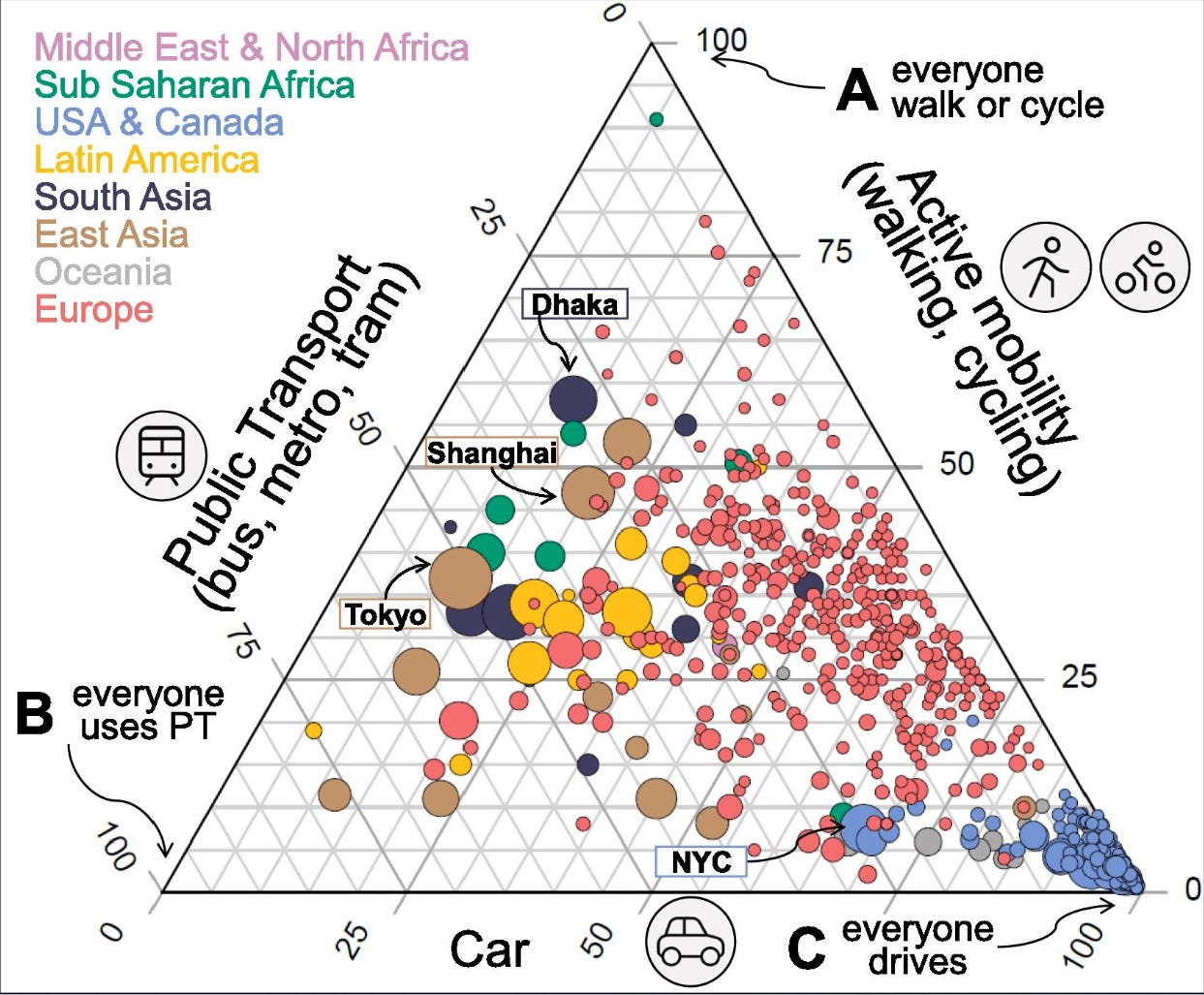
GRAPH IT. A 2024 study looked at global mode share (the percentage share of trips by car, public transport, walking, cycling etc) relative to city size in almost 800 cities in 61 countries. Perhaps one of the most stark things about it are the triangle graphs highlighting mobility trends by global region. US and Canadian cities are huddled in the ‘everyone drives’ corner, while East Asia tends more towards public transit and European countries towards walking and cycling. Larger cities generally see more public transport usage - outside of North America, that is. Thanks to Brent Toderian for bringing this to our attention.
PAINT IT. It would be ludicrous that the most dangerous roads have the flimsiest cycle lanes, but that’s what one study has concluded in America. A terrifying 61% of painted cycle lanes in the US are on ‘high stress’ corridors - fast, multi-lane arterial roads where few would brave cycling. Less than 40% are on ‘low-stress’ streets. Paint-only cycle lanes can be worse than no lane, safety-wise as they encourage passing drivers to close-pass riders, by hugging the white line. Researchers also conclude these poor examples of cycle lanes, by being so unattractive, can undermine support for wider cycling infrastructure.
OTHER HEADLINES
CROSS IT. James Watt Queensway in Birmingham is a relic of an experiment that went wrong. This kind of car-centric infrastructure in city centres cuts off parts of the city from one another, slows down pedestrian journeys and discourages people from exploring beyond lower-traffic islands. Big roads and mega junctions have no place in busy cities and so, while it’s a good step to see plans to make crossing James Watt Queensway easier, a better one is to remove these relics altogether.
INTERESTING GRAPH OF THE WEEK: The triangle of mobility. Source:
ACTIVE TRAVEL WORD OF THE WEEK:
Cruising for parking. An often invisible phenomenon in road transport driven largely by the cost of on-street parking. A phenomenon identified by the late great Donald Shoup, cruising for parking can be surprisingly predictable, and therefore manageable with good, i.e. charging, parking policies. Reducing cruising for parking helps reduce circulating motor traffic, goes the theory.
Until next time,
Adam Tranter
CEO, Fusion & Founder, #BikeIsBest
This newsletter is brought to you by Fusion, the agency for movers, specialising in communications and public affairs for active travel and mobility.

So, what is the source of The Triangle of Mobility, and might it provide us with a graphic with all of the cities labelled? Though thinking about it is alone a useful exercise, I find it hard to assess where, for example, London, Edinburgh or provinical British cities fall. JM