


This week, I’ve been at the Making Active Places conference in Manchester - Active Travel England’s first annual get-together sharing knowledge and best practice across transport and placemaking. Elsewhere there’s calls for e-moto bans, warnings over bigger car bonnets, and we look to Barcelona where e-bike subsidies are the latest solution for a city already hit hard by the climate crisis.
BIG STORIES FOR CYCLING ADVOCACY
GET E-MOTO MENACE OFF OUR ROADS. The Guardian’s senior political correspondent, Peter Walker, has waded into the illegal e-moto debate, calling to ‘get this menace off our roads’. Walker says while some shared e-bike riders can be inconsiderate, it’s important not to conflate legal machines with what are effectively e-motorbikes. He notes, wryly, the problem is centred around the places you see most journalists and most politicians: inner London. The problem, he says, is not a cycling one, it’s a law enforcement one, and conflating the issues is harming the use of legal e-bikes.
£104M FOR NATIONAL CYCLE NETWORK. Most of us acknowledge the National Cycle Network is patchy and needs better investment. This week, the government announced £104m over four years to improve sections of it. Among the projects slated for improvements are the English portion of the Avenue Verte (the route linking London and Paris whose English side is currently rather patchy), and bits of routes connecting to the HS2 corridor. Also on the list are some new routes and programmes to improve accessibility, school streets and help community-led projects. It’s not the only funding the NCN will get in the next four years, thankfully, but it’s a start.
LARGER VEHICLES HARM PEDESTRIANS. Larger vehicles may feel safer for their inhabitants, but they make the rest of us on the outside feel less safe. New research from Australia quantifies this threat. Analysing 10,000 crashes where drivers hit pedestrians, they found for every 10cm of vehicle height increase, the odds of a pedestrian death rise by 11 per cent, and each 100kg increases fatality odds by 6%. While UK vehicles aren’t as big as Australia’s, let alone US trucks, they are growing each year. Knowing this risk, with such stark figures, should give policymakers pause - and should make carmakers liable for their lethal products.
BARCELONA SUBSIDISES E-BIKE PURCHASE. Governments should be celebrating the power of e-bikes to improve population health, the urban environment and to help cut carbon emissions. That’s exactly what Barcelona’s city government is doing. In recognition of the value of sustainable mobility, €4m will be available over four years to help residents buy e-bikes (€400 per person) and e-cargo cycles (€800 per person). The idea is to address unequal access to e-mobility among lower-income residents. Meanwhile, the city is expanding its cycle network and public cycle hire fleet, as part of its climate plan.
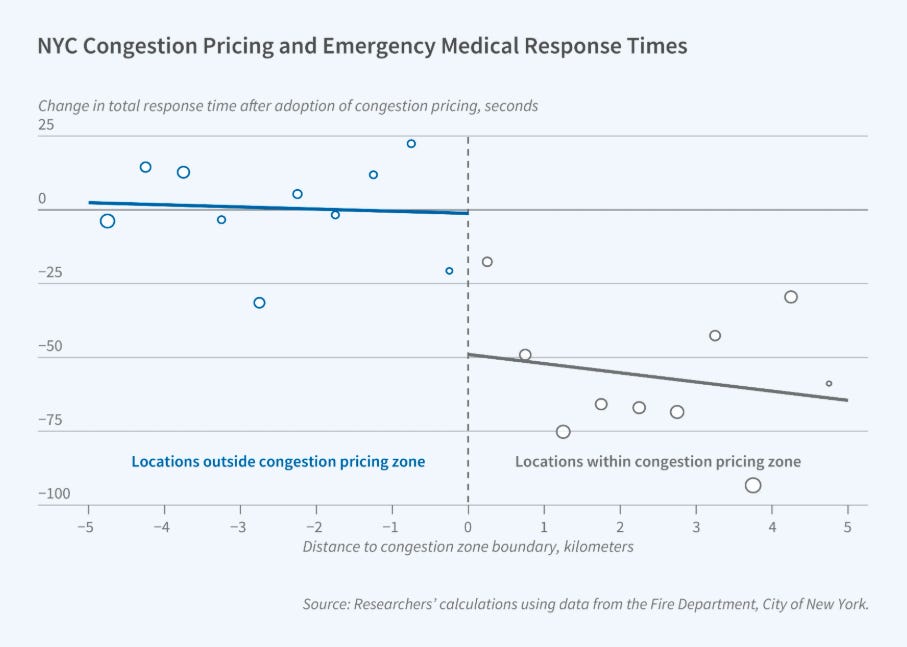
NYC CONGESTION PRICING IMPROVES EMERGENCY RESPONSE TIME. Opposition to traffic reduction often centres around the impact on emergency service responses. New data from New York City shows emergency medical service (EMS) responses improved since congestion pricing came in. Analysis of dispatch records for around half a million incidents, combined with traffic camera data, found within 5km of the zone ambulance travel time between an incident and hospital fell by 54-59 seconds - around 8% faster than pre-congestion charge times. Meanwhile, fewer passenger vehicles, and more pedestrians and cycles were measured in the zones. What do you know: New Yorkers are walking here - and enjoying better chances of survival in an emergency.
OTHER HEADLINES
A NEW START AFTER 60. The Guardian’s ‘new start after 60’ series is often inspiring, and this one is no different. This time it features the story of Arthur Plummer, who joined a cycle club at 65 and is still going strong, aged 92. What’s more, he’s still clocking up 5,000km a year. Plummer talks movingly about his connection to the bike, how he can cycle thousands of miles, even while walking is a struggle, and his remarkable energy levels. We can only hope for a tenth decade as adventurous. Chapeau!
INTERESTING GRAPH OF THE WEEK: The improvement in Emergency Medical Response times following the introduction of congestion pricing in New York City. source: https://www.nber.org/digest/202609/urban-congestion-pricing-and-response-times-emergency-medical-services?page=1&perPage=50
ACTIVE TRAVEL WORD OF THE WEEK:
Wayfinding. Simply, it’s how we navigate a route or network. Active Travel England is looking to improve cycle network wayfinding, as part of its national plans for active travel. This may involve signposts, paint, digital wayfinding and more.
Until next time,
Adam Tranter
CEO, Fusion & Founder, #BikeIsBest
This newsletter is brought to you by Fusion, the agency for movers, specialising in communications and public affairs for active travel and mobility.
