


This week, I’m talking about another ‘cycling scourge’ TV piece - this time with e-bikes in the frame. If it sounds familiar there’s a reason. Meanwhile, Low Traffic Neighbourhoods cut pollution and crashes, and support local shops - and there’s new data on the power of investing in cycling. As well as data on the lack of enforcement on alleged dangerous cycling (spoiler: it’s not the real issue). Elsewhere, Waymo cars have been fined - a lot, and street greening gets a glow up.
BIG STORIES FOR CYCLING ADVOCACY
PREJUDICE AS ENTERTAINMENT? Channel 5 has reimagined a programme from 2019 describing cycling as a ‘scourge’ - this time about people on ‘e-bikes’. You might guess they’ve conflated illegal e-motorbikes with e-bikes throughout the piece. These programmes offer a chance to investigate an issue, and I’d have loved to see some tough questions about gig economy companies. Another question might be, why are people like delivery riders on low pay using these dangerous machines in the first place? Sadly this programme had nothing of the sort to offer. I wrote some of my thoughts - and offered some real solutions - this week.
DANGEROUS COWS LATEST. In an ideal world, everyone would follow the rules. But with limited resources, police rightly focus on major causes of harm; last year, 364 pedestrians were killed, almost all of them hit by motor vehicles. In comparison, more pedestrians are killed by cows than cyclists. I don’t condone poor riding that endangers pedestrians, I make a nuanced point in The Times’ piece “Do police in your area let reckless cyclists ride roughshod?” (also referenced in Cycling Weekly, here) that it’s unreasonable to expect it to be any other way with the systems we have.
My ideal world would be more roads policing with enough free capacity to be able to focus on the annoying or intimidating behaviour of all road users. But it’d still likely be focused on the most significant causes of harm. But as it currently is, roads policing are often occupied with clearing up after fatal and serious collisions (statistically nearly always caused by drivers). Yet, based on the prominence bad cycling gets in national media, you’d think cycling (a mostly benign activity) is one of the biggest dangers to us all.
POSITIVE LTN DATA FROM OXFORD. Oxford campaigners analysed data from before and after Low Traffic Neighbourhood installation and found collision casualties have reduced within the Cowley Road LTN and on boundary roads. Using CrashMap data the Coalition for Healthy Streets and Active Travel (CoHSAT) found around 100 fewer casualties post-vs pre-LTN. Boundary roads with multiple turnings saw the greatest casualty reductions. One primary school has more pupils walking, scooting and cycling, too - up from 64% to 83% in one class - and fewer children being driven. Air pollution across the city has reduced, partly attributable to citywide measures. It’s a good piece of research from a local campaign group and includes some powerful testimonials from residents.
OXFORD STREET GOES TRAFFIC-FREE. Next week England’s high street will be open only to pedestrians and emergency services, in the first phase of its pedestrianisation. Living Streets has welcomed the move, and is calling for other cities to follow suit. Edinburgh has pedestrianised bits of the Royal Mile, Belfast faces calls for further pedestrianisation after a successful street festival in the summer, and Cardiff’s Queen Street has been pedestrianised for half a century. Research shows streets better designed for walking and wheeling thrive. How those cycling in the Oxford Street area will fare on the local diversions is to be seen.
WAYMO’S $1M PARKING TICKETS. The argument for robotaxis is often that they are safer drivers than humans and will always follow the rules. However, data obtained by the San Francisco Gazetteer reveals Waymo vehicles earned 4,131 tickets for traffic infractions in the year to July - against 4,178 for the whole of 2025. The cars aren’t learning: they received 577 tickets from one spot at Fisherman’s Wharf, San Francisco. Could this be a tech company just doing what it wants? Surely not.
BIG RETURNS FOR CYCLING. Money invested in cycling tends to be money well spent - though the power of cycling is often underestimated. New research from Cycling UK analyses the impact of cycling schemes across Britain, from school streets to new protected routes, and finds, on average, for each £1 spent, £5.62 is “returned via downstream savings” - i.e., benefits to physical and mental health, congestion and pollution reduction, and boosts to local businesses. The Route Forward finds infrastructure needs to be accessible and to enable uninterrupted journeys, without scary bits. Trials, it says, are a useful way to inform decisions.
OTHER HEADLINES
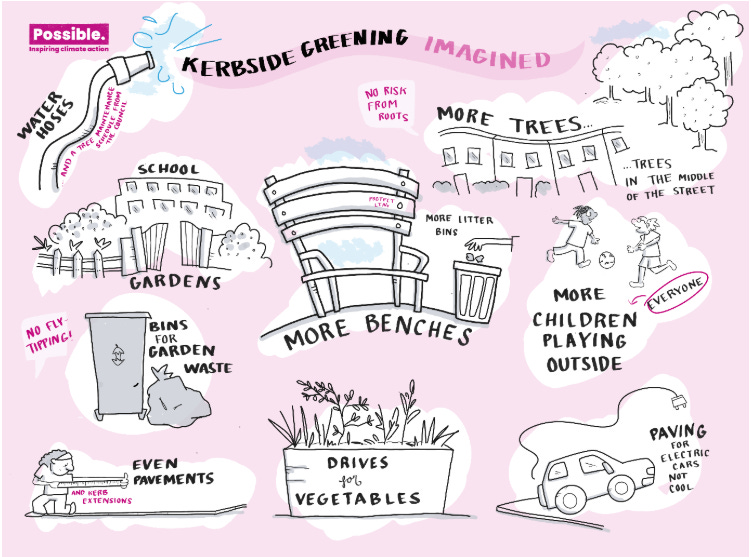
GREEN CITIES, HAPPY CITIES. Over the summer climate charity, Possible, launched a new report on kerbside greening to mitigate extreme heat. With the Super El Niño predicted to bring a winter of intense rainfall, these green spaces in our communities are as important in reducing the risk of flooding by soaking up rain before it can overwhelm drains and rivers. Changing the way we manage our streets, and what we prioritise, means reducing car parking. The payback: nature surviving - and thriving - in urban areas, as this piece on Freiberg shows. There, citizen-maintained tree beds have boosted biodiversity.
INTERESTING GRAPH OF THE WEEK: Imagining something different. One of the illustrations from Possible’s community workshops on what a greener, healthier streetscape might look like. Source: https://www.wearepossible.org/latest-news/new-report-kerbside-greening
ACTIVE TRAVEL WORD OF THE WEEK:
Pedestrianisation. The process of transforming a former traffic thoroughfare into a space primarily for walking or wheeling - with exceptions for things like emergency vehicles or deliveries. After pedestrianisation, despite predictions, the world does not usually end.
Until next time,
Adam Tranter
CEO, Fusion & Founder, #BikeIsBest
This newsletter is brought to you by Fusion, the agency for movers, specialising in communications and public affairs for active travel and mobility.
